Dealing with a plumbing problem right now?
📞 Call now — get matched with a licensed local plumber: (737) 283-6243Have your address and a quick description of the problem ready — the call takes about 2 minutes.
Licensed local pros · Fast response, subject to availability · No obligation
Quick answer: A water heater leaking from the bottom is either a loose drain valve, a temperature-and-pressure (T&P) discharge pipe routed down the side, or — the serious one — a corroded tank. Valve problems are fixable; a leaking tank is not, and it can fail completely with little warning. Shut off the cold-water supply and the power or gas first, then figure out which of the three you have. If water is coming from the tank body itself, the licensed local plumber you’re matched with can confirm it and walk you through replacement options the same day. If you need a licensed plumber, see our page on tankless installation pricing. Our page on water heater replacement covers what to expect.
Few things sink a Saturday like a spreading puddle under the water heater. In Austin, where tanks live in garages, closets, and attics above living space, a bottom leak deserves fast triage — partly because of what it can ruin, and partly because our mineral-heavy water means the worst-case explanation is more common here than in softer-water cities. Here is how to tell what you are looking at and what to do in the next thirty minutes.
Is a water heater leaking from the bottom an emergency?
Treat it as urgent until proven otherwise. A slow drip from a valve can wait a day; a weeping tank seam cannot, because internal corrosion only moves in one direction. A standard tank holds forty to fifty gallons, and if the bottom lets go, all of it comes out at once — followed by the cold supply line refilling the tank onto your floor until someone shuts it off. For attic and second-floor installations, which are common in newer Austin subdivisions, that failure mode means ceilings, insulation, and drywall, not just a wet garage slab.
Where is the water actually coming from?
Dry the area completely with a towel, then watch for fresh moisture. Bottom leaks trace back to one of four sources:
- The drain valve. The spigot near the tank’s base can loosen, or its washer can wear out. Water beads at the valve outlet or the threads. This is the easy one.
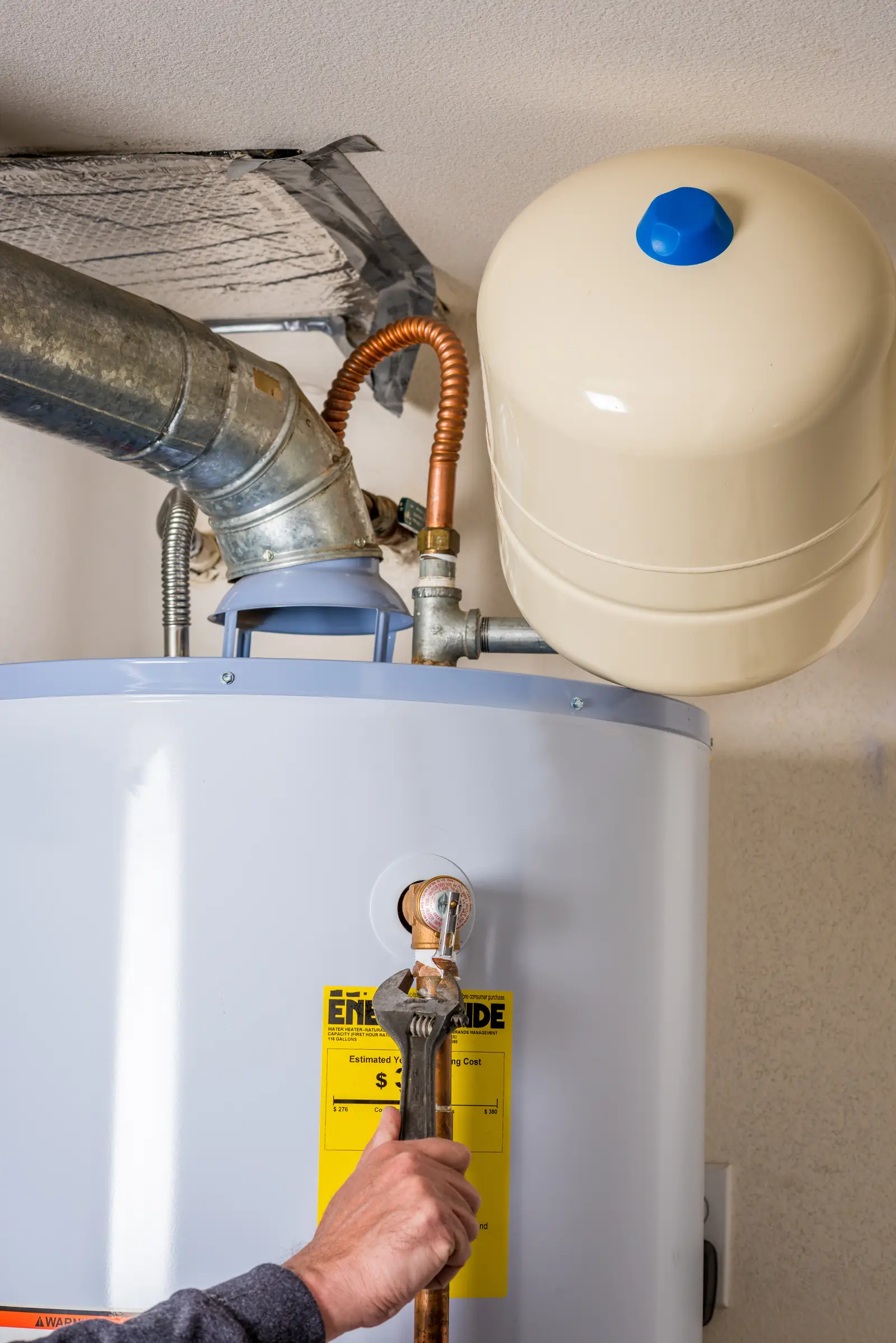
- The T&P relief valve discharge. The safety valve sits high on the tank, but its discharge pipe runs down the side and ends near the floor — so a T&P leak looks like a bottom leak. Intermittent water here can mean excess pressure or temperature, which is a system problem, not a drip to ignore.
- Condensation. A gas heater refilling with cold water in a humid Austin garage can sweat enough to puddle. If the moisture appears after heavy hot-water use and vanishes as the tank heats, condensation is the likely story.
- The tank itself. Water seeping from under the outer jacket, rust streaks below the seams, or moisture you cannot trace to any fitting means the inner tank has corroded through. No sealant or part swap reverses this — the unit is at end of life.
Why do Austin water heaters fail from the bottom so often?
Sediment. Austin’s drinking water comes from the Colorado River through limestone country, and Austin Water’s own quarterly water quality summaries track the total hardness that comes with it — enough dissolved calcium and magnesium that scale is a fact of life in local plumbing. Inside a tank heater, those minerals precipitate every heating cycle and settle on the bottom as a layer of sediment. That layer does two destructive things:
- It insulates the burner from the water on gas units, so the steel bottom overheats, expands, and fatigues — the popping and rumbling you hear is water boiling through the sediment layer;
- It chews through the sacrificial anode rod faster, and once the anode is gone, corrosion starts eating the tank liner itself.
The result: tanks in Austin routinely age faster than their warranty period implies, and the bottom of the tank — where the sediment sits — is where they give out. An annual flush and an anode check meaningfully slow this down, which is exactly what a water heater flush and maintenance visit in Austin covers.
What should you do right now?
- Shut off the cold-water supply. There is a valve on the cold inlet line above the heater. If it is stuck, use the home’s main shutoff.
- Kill the energy source. Flip the breaker for an electric unit; turn the gas control to OFF for a gas unit. Heating an emptying tank ruins elements and can create pressure.
- Protect the area. Towels and a shallow pan buy time; move storage boxes away from the tank. If the unit sits in an attic, check the emergency drain pan and make sure its line is not clogged.
- Test your findings. Dry everything, then check the drain valve, the T&P discharge, and the jacket seams in that order over an hour.
Repair or replace?
The dividing line is simple: fittings can be repaired, tanks cannot. A worn drain valve or a misbehaving T&P valve is a straightforward part replacement. But if the leak is from the tank body — or the unit is past roughly ten years old with rusty hot water and rumbling on top of the leak — replacement is the honest answer, and the choice becomes tank versus tankless, capacity, and placement. For a bottom-leaking tank above living space, err on the side of moving fast: the gap between “weeping” and “let go” is unpredictable.

When should you bring in a licensed plumber?
If the leak traces to the tank body, if you cannot isolate the source, or if the T&P valve keeps discharging after you have lowered the thermostat, stop there — those are licensed-work territory in Texas. A dispatch request through water heater repair in Austin connects you with a licensed local plumber who can pressure-test, confirm whether the tank is condemned, and quote replacement on the spot. If the tank is actively dumping water and you cannot get the supply shut off, treat it like any burst-line event and use the 24/7 emergency plumber line for Austin instead — nights and weekends included.
Frequently asked questions
Can I keep using hot water while the tank leaks?
If the leak is a slow valve drip and the tank is sound, short-term use is generally tolerable. If water is coming from the tank body, shut it down — continuing to heat a corroding tank accelerates the failure.
Will draining the tank stop a bottom leak?
Draining stops the water damage but does not fix anything. It is the right move after shutoff for a condemned tank, and it makes the eventual swap faster.
How long do water heaters last in Austin?
Local plumbers commonly see tank units retire earlier here than the ten-to-twelve-year figure quoted nationally, mostly because of sediment load. Annual flushing and anode replacement are the two habits that push a tank toward the long end of the range.
Does homeowners insurance cover a failed water heater?
Policies typically cover the sudden water damage a failed tank causes, but not the worn-out heater itself. Check your policy language and document the damage with photos before cleanup.
Local Geological, Water-Hardness & TSBPE Code Benchmarks: Austin, TX
| Austin Plumbing Engineering Factor | Austin, TX (Greater Austin & Hill Country) Field Specification |
|---|---|
| Sub-Slab Geology & Soil Movement | Balcones Escarpment split: fractured Edwards limestone west of Mopac vs. expansive Houston Black clay east/south |
| Local Water Hardness & Anode Impact | Austin Water / Edwards & Colorado River blend (200–300 mg/L CaCO₃; up to 360+ mg/L on Hill Country wells) — depletes standard magnesium anode rods in 3–4 yrs |
| Dominant Neighborhood Pipe Cohort | Pre-1985 galvanized/cast-iron bungalows, 1985–2002 copper slabs, and 2005+ two-story PEX/CPVC tracts |
| Leading Local Dispatch Triggers | Limestone sediment water heater failures, clay-shift slab leaks, PRV spikes & live-oak root sewer clogs |
| Texas Licensing & Municipal Permit Rule | TSBPE-Licensed Master Plumber required; City of Austin permits mandatory for water heaters, repipes & sewer/gas lines |
| Typical Greater Austin Market Ranges | $175–$450 (Drain/Valve/PRV Service) | $1,650–$3,800 (Permitted Tank/Tankless Swap) | $2,200–$6,500+ (Slab Reroute/Sewer) — Call (737) 283-6243 |


How much does a plumber cost in Austin, TX?
In Austin, TX, standard plumbing repairs such as faucet cartridges, toilet rebuilds, PRV swaps, and single-drain snaking typically range from $175 to $450. Permitted 50-gallon tank water heater replacements average $1,650 to $2,900, while electronic slab leak detection and overhead PEX reroutes range from $1,800 to $4,800+.
Do you need a permit to replace a water heater in Austin?
Yes, the City of Austin and surrounding Central Texas municipalities require a residential plumbing permit and final inspection for any tank or tankless water heater replacement in Austin, TX. Code compliance requires a thermal expansion tank, a full-size T&P discharge line, a drain pan, and a gas sediment trap.
Why do slab leaks happen so often in Austin, TX?
Slab leaks in Austin, TX are driven by two local factors: expansive Houston Black clay that swells and shrinks 3 to 6 inches seasonally beneath concrete slabs, and mineral-heavy Edwards Aquifer water (200 to 300+ mg/L CaCO₃) that accelerates pinhole corrosion inside buried copper hot-water loops.
Priority Austin Plumbing, Water Heater & Slab Leak Dispatch Hubs
Need same-day or 24/7 service from an independent TSBPE-licensed Master Plumber? Connect directly with our primary hubs for 24/7 emergency plumber in Austin, TX, water heater replacement in Austin, TX, slab leak detection in Austin, TX, and drain cleaning & hydro-jetting in Austin, TX.
Compare local permit and soil requirements in our City of Austin water heater permit guide, Houston Black clay slab leak guide, and neighborhood pages for South Austin (78704/78745), Circle C Ranch, Round Rock, and Cedar Park.
Frequently Asked Questions: Water Heater Leaking From the Bottom ? What to Do in Austin, TX
How fast can a TSBPE-licensed Master Plumber arrive in Austin, TX?
When you call our 24/7 dispatch line at (737) 283-6243, a live coordinator matches your Austin, TX ZIP code with the nearest available independent TSBPE-licensed Master Plumber. Active burst pipes, main sewer backups, and gas red-tags receive priority emergency routing day or night, while standard repairs typically book same-day.
Does the dispatched plumber provide a written estimate before starting water heater leaking from the bottom ? what to do in Austin, TX?
Yes, every independent Master Plumber connected through our Austin, TX dispatch line inspects the problem on site first and provides a clear, written line-item estimate before turning a wrench. The dispatch call is completely free, and you are under zero obligation to proceed until you approve the plumber's quote.
Are City of Austin plumbing permits pulled for water heater and sewer replacements in Austin, TX?
Yes, Texas law and the City of Austin Plumbing Code require permits and inspections for water heater replacements, whole-house repipes, gas line pressure tests, and main sewer replacements. Our dispatched TSBPE-licensed Master Plumbers handle permit pulling, thermal expansion tank sizing, and city inspector sign-off as standard practice.
Why does hard water in Austin, TX cause water heaters and fixtures to fail early?
Municipal and well water across Austin, TX draws from limestone aquifers averaging 200 to 340+ mg/L of calcium carbonate hardness. That mineral load consumes standard water heater anode rods in just 3 to 4 years, bakes rock sediment onto tank bottoms, and scales over tankless heat exchangers without annual flushing.
What should I do first if a pipe bursts or my slab is leaking in Austin, TX?
First, shut off your main water valve at the street meter box or exterior garage wall to stop active water flow, and turn off the power or gas burner to your water heater. Next, open the lowest cold faucet to relieve pressure and call (737) 283-6243 for immediate 24/7 dispatch.