Texas Water Heater Freeze Prep in Austin, TX
Quick answer: Texas water heaters fail in freezes at their connections, not their tanks: flex connectors, TPR discharge lines and exposed nipples split first, and tankless units die when outages kill their electric freeze protection. The pre-winter checklist: insulate connectors and discharge lines, jacket garage tanks, seal garage-door thresholds, keep tankless units powered (or drain them in an outage), know the cold-inlet shutoff, and during hard freezes keep a hot tap dripping. Ten minutes in November prevents the burst-connector flood and the no-hot-water week in February.
Every hard Texas freeze produces the same two water-heater casualties, thousands of times over. The first is the garage tank whose braided connectors froze and split — discovered when the garage floods or the hot water quits. The second is the tankless unit that sailed through the cold snap right up until the power blinked, lost its electric freeze protection, and split its heat exchanger in the outage hours — the failure that turned February 2021 into a statewide appliance funeral.
Both are almost entirely preventable, and the prevention is cheap, unglamorous and at its most effective in fall — before the first norther, while hardware stores still have pipe insulation and plumbers still have open calendars. Here is the whole playbook: why Texas installations are uniquely exposed, what actually fails, the pre-winter checklist, and what to do during the freeze itself.
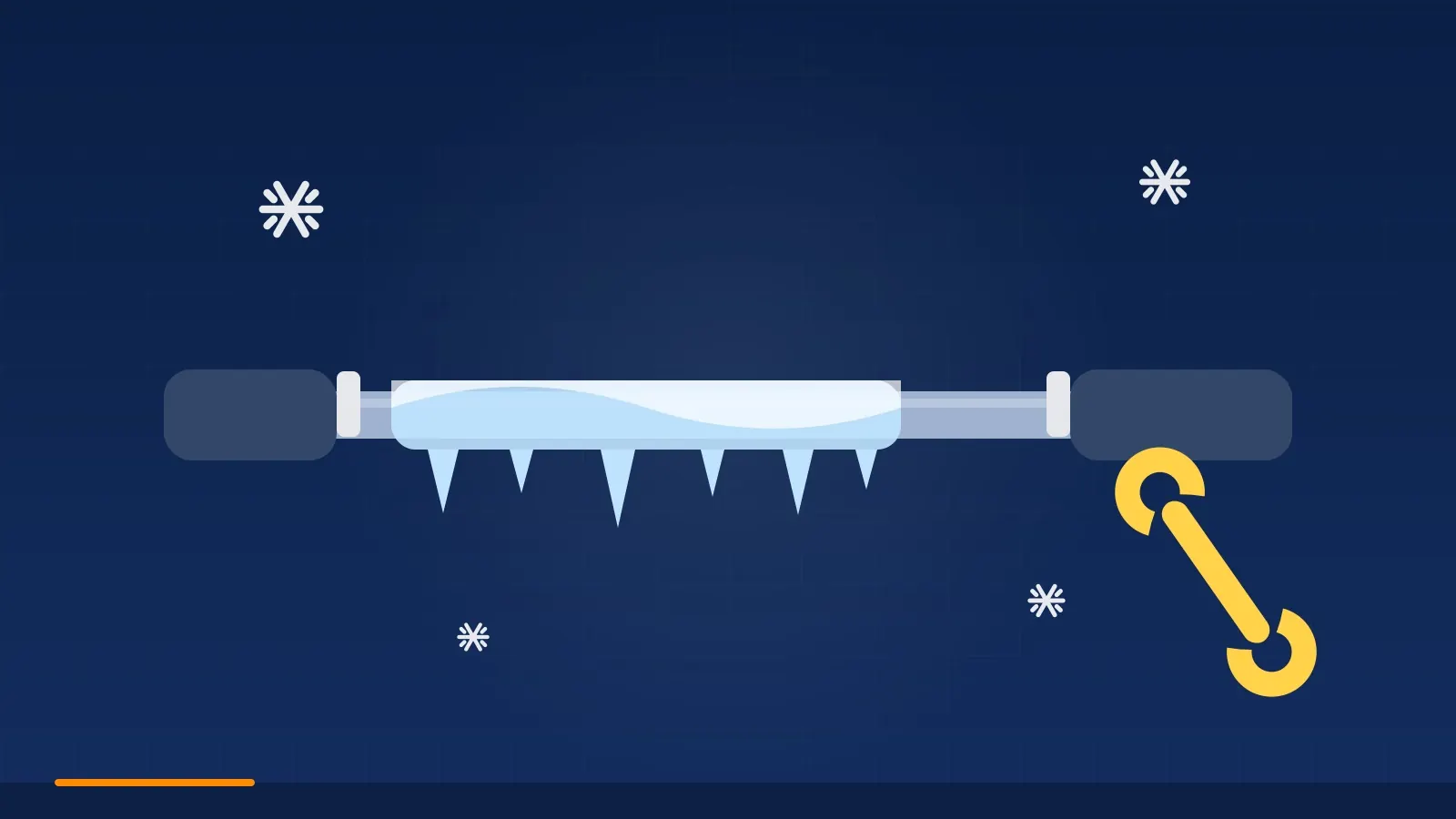
The tank itself is actually the survivor: forty gallons of heated water in an insulated cylinder takes days to freeze. What fails is everything attached to it — thin braided flex connectors holding still water, the TPR discharge line, exposed nipples and valves, and recirculation lines. Those small-diameter, uninsulated, low-mass components freeze in hours, and they fail at full line pressure. The tank keeps working; the fittings flood the garage.
Tankless units invert the risk profile. They hold almost no water, so they freeze fast — and manufacturers answer with built-in electric freeze protection: small heaters inside the cabinet that keep the exchanger above freezing. It works flawlessly until the grid fails. In an outage during a hard freeze, an exterior-wall or garage tankless unit has minutes-to-hours before the exchanger splits — which is why outage-hour drain-down (below) is the one tankless skill every Texas owner should have.
The pre-winter checklist, in order
Run this in October or November, before the first front:
- Insulate the connectors: foam pipe insulation on the hot and cold flex lines, the first few feet of both pipes, and the TPR discharge line. This is the single highest-value item on the list.
- Jacket older garage tanks: an insulating blanket on a pre-2015 garage tank helps both freeze resilience and standby loss. (Skip on newer high-insulation tanks and never block the burner compartment, controls or TPR valve.)
- Seal the space: weatherstrip the garage-door threshold, fix gaps in exterior-closet doors, and in attics make sure wind cannot path across the unit from soffit vents.
- Find the shutoffs now: the cold-inlet valve above the tank isolates the heater; the main shutoff and curb stop isolate the house. Every adult should know all three.
- Verify tankless freeze protection: confirm the unit has power (freeze protection runs on the wall plug, not the gas), locate the isolation valves and drain ports, and read your model’s outage drain-down procedure before you need it in the dark.
- Check the attic pan: for attic tanks, confirm the drain pan is intact and its drain line actually daylights — a freeze-split connector over a non-draining pan is a ceiling collapse.
- Service the tired: a unit already rumbling, leaking at fittings, or past twelve years is the one the freeze will finish. Replace or repair on an October schedule, not a February emergency — the coldest week is always replacement week, and it is a seller’s market.
During the freeze: what to actually do
When a hard freeze warning posts, the active measures begin. Keep the garage door closed all day — every opening dumps the accumulated heat. Drip a hot tap (not just cold: a hot-side drip pulls warmer water through the heater’s vulnerable connections continuously) at the fixture furthest from the heater. Open cabinet doors under sinks on exterior walls. If the house has a recirculation pump, run it continuously through the freeze — moving water resists freezing.
If the power fails and you have a tankless unit on an exterior wall or in a garage: act within the hour. Close the gas and the cold inlet, open the drain ports (your fall homework located them), and let the exchanger empty — an empty exchanger cannot split. When power returns, close the drains, reopen the valves, restore gas, and the unit restarts. This five-minute procedure is the difference between the units that survived 2021’s outages and the thousands that did not.
After the thaw: the audit nobody runs
The thaw is when splits announce themselves — ice plugs melt and pressurized water finds the cracks the freeze cut. After temperatures recover: walk the heater’s fittings with a flashlight and a paper towel (weeps show on paper before they show on concrete), run the meter test for hidden leaks, check the attic pan for new water, and glance at the TPR valve — freeze-stressed relief valves sometimes stick or weep afterward. Our page on annual water heater flush covers what to expect.
And log what the freeze taught you: which faucet ran slow (that line froze partially — insulate it), whether the garage held temperature, how the tankless behaved. Texas freezes repeat — 2021, 2022, 2023 each ran the experiment — and each house fails the same way every time until someone fixes the specific weak point. The checklist above is generic; your house’s version, learned from one freeze and fixed in one fall afternoon, is permanent.
Heater already rumbling with a front in the forecast?
October’s repair beats February’s queue. Describe the unit — age, location, symptoms — and your city, and the dispatch line matches you with an independent TSBPE-licensed plumber across Texas’s metros, 24/7, before the norther makes the appointment for you.
Freeze-prep questions, answered straight
Will my water heater tank itself freeze solid?
Almost never — forty-plus gallons of heated, insulated water takes days of hard cold to freeze, and the burner keeps replacing lost heat as long as gas and water flow. The realistic failures are peripheral: connectors, valves, TPR discharge lines and recirculation loops freeze and split in hours. Protect the periphery and keep the unit fueled, and the tank protects itself. The exception: a tank left without power/gas in a vacant house — drain it for winter absences.
My tankless unit says it has freeze protection. Am I covered?
Covered while the electricity flows — the protection is electric heating elements inside the cabinet, powered from the wall, independent of gas. In an outage the protection dies with the lights, and exterior or garage units can split their heat exchangers within hours in a hard freeze. The answer is the drain-down: close gas and inlet, open the drain ports, empty the exchanger. Learn the procedure for your model this fall; it is five minutes that saves a four-figure component.
Should I turn my water heater off during a freeze?
No — the opposite. A firing heater is your ally: it keeps its own plumbing warm and supplies the hot-side drip protecting the lines. Turn a tank heater off only if you are draining the house for an absence or a failure has already occurred (then kill gas/power so it does not dry-fire). During outages, gas tank heaters with standing pilots keep working — one of their quiet advantages in Texas winters.
What temperature should trigger the freeze routine?
Treat a forecast of 27°F or below for several hours — or any hard-freeze warning with wind — as the trigger. Wind is the multiplier: moving air strips heat from garages, attics and exterior closets far faster than still cold, which is why Panhandle and North Texas homes run the routine earlier and more often. When in doubt, run it: dripping a tap and closing a garage door cost pennies against a split connector’s flood.
Is a February heater failure an insurance claim?
The water damage a split connector or failed tank causes — flooring, drywall, contents — is commonly covered as sudden discharge; the heater repair itself usually is not. Freeze claims can hinge on whether the home was heated and reasonably protected, which is exactly what the checklist documents. Photograph the damage as found, keep the failed part, note the timeline, and get the plumber’s written cause finding — those four items carry the conversation.
About this site: ATX Plumbing Pros is a dispatch and referral service, not a licensed plumbing contractor. All plumbing work referenced here is performed by independent Texas-licensed (TSBPE) plumbers who hold their own license, insurance and bond. This article is general information, not professional advice for your specific system.
Local Geological, Water-Hardness & TSBPE Code Benchmarks: Austin, TX
| Austin Plumbing Engineering Factor | Austin, TX (Greater Austin & Hill Country) Field Specification |
|---|---|
| Sub-Slab Geology & Soil Movement | Balcones Escarpment split: fractured Edwards limestone west of Mopac vs. expansive Houston Black clay east/south |
| Local Water Hardness & Anode Impact | Austin Water / Edwards & Colorado River blend (200–300 mg/L CaCO₃; up to 360+ mg/L on Hill Country wells) — depletes standard magnesium anode rods in 3–4 yrs |
| Dominant Neighborhood Pipe Cohort | Pre-1985 galvanized/cast-iron bungalows, 1985–2002 copper slabs, and 2005+ two-story PEX/CPVC tracts |
| Leading Local Dispatch Triggers | Limestone sediment water heater failures, clay-shift slab leaks, PRV spikes & live-oak root sewer clogs |
| Texas Licensing & Municipal Permit Rule | TSBPE-Licensed Master Plumber required; City of Austin permits mandatory for water heaters, repipes & sewer/gas lines |
| Typical Greater Austin Market Ranges | $175–$450 (Drain/Valve/PRV Service) | $1,650–$3,800 (Permitted Tank/Tankless Swap) | $2,200–$6,500+ (Slab Reroute/Sewer) — Call (737) 283-6243 |
How much does a plumber cost in Austin, TX?
In Austin, TX, standard plumbing repairs such as faucet cartridges, toilet rebuilds, PRV swaps, and single-drain snaking typically range from $175 to $450. Permitted 50-gallon tank water heater replacements average $1,650 to $2,900, while electronic slab leak detection and overhead PEX reroutes range from $1,800 to $4,800+.
Do you need a permit to replace a water heater in Austin?
Yes, the City of Austin and surrounding Central Texas municipalities require a residential plumbing permit and final inspection for any tank or tankless water heater replacement in Austin, TX. Code compliance requires a thermal expansion tank, a full-size T&P discharge line, a drain pan, and a gas sediment trap.
Why do slab leaks happen so often in Austin, TX?
Slab leaks in Austin, TX are driven by two local factors: expansive Houston Black clay that swells and shrinks 3 to 6 inches seasonally beneath concrete slabs, and mineral-heavy Edwards Aquifer water (200 to 300+ mg/L CaCO₃) that accelerates pinhole corrosion inside buried copper hot-water loops.
Priority Austin Plumbing, Water Heater & Slab Leak Dispatch Hubs
Need same-day or 24/7 service from an independent TSBPE-licensed Master Plumber? Connect directly with our primary hubs for 24/7 emergency plumber in Austin, TX, water heater replacement in Austin, TX, slab leak detection in Austin, TX, and drain cleaning & hydro-jetting in Austin, TX.
Compare local permit and soil requirements in our City of Austin water heater permit guide, Houston Black clay slab leak guide, and neighborhood pages for South Austin (78704/78745), Circle C Ranch, Round Rock, and Cedar Park.
Frequently Asked Questions: Texas Water Heater Freeze Prep in Austin, TX
How fast can a TSBPE-licensed Master Plumber arrive in Austin, TX?
When you call our 24/7 dispatch line at (737) 283-6243, a live coordinator matches your Austin, TX ZIP code with the nearest available independent TSBPE-licensed Master Plumber. Active burst pipes, main sewer backups, and gas red-tags receive priority emergency routing day or night, while standard repairs typically book same-day.
Does the dispatched plumber provide a written estimate before starting texas water heater freeze prep in Austin, TX?
Yes, every independent Master Plumber connected through our Austin, TX dispatch line inspects the problem on site first and provides a clear, written line-item estimate before turning a wrench. The dispatch call is completely free, and you are under zero obligation to proceed until you approve the plumber's quote.
Are City of Austin plumbing permits pulled for water heater and sewer replacements in Austin, TX?
Yes, Texas law and the City of Austin Plumbing Code require permits and inspections for water heater replacements, whole-house repipes, gas line pressure tests, and main sewer replacements. Our dispatched TSBPE-licensed Master Plumbers handle permit pulling, thermal expansion tank sizing, and city inspector sign-off as standard practice.
Why does hard water in Austin, TX cause water heaters and fixtures to fail early?
Municipal and well water across Austin, TX draws from limestone aquifers averaging 200 to 340+ mg/L of calcium carbonate hardness. That mineral load consumes standard water heater anode rods in just 3 to 4 years, bakes rock sediment onto tank bottoms, and scales over tankless heat exchangers without annual flushing.
What should I do first if a pipe bursts or my slab is leaking in Austin, TX?
First, shut off your main water valve at the street meter box or exterior garage wall to stop active water flow, and turn off the power or gas burner to your water heater. Next, open the lowest cold faucet to relieve pressure and call (737) 283-6243 for immediate 24/7 dispatch.