Dealing with a plumbing problem right now?
📞 Call (737) 283-6243Free 24/7 dispatch line · licensed local plumbers · no obligation
Quick answer: A tank water heater costs less to install and recovers fast, but runs out of hot water under heavy demand and typically lasts 8–15 years depending on local water hardness. A tankless unit delivers unlimited hot water and runs closer to 20 years, but costs more upfront and often needs a gas line upsize plus annual descaling on Central Texas’s hard water. The Austin water heater replacement dispatch line connects you with a licensed local plumber who sizes the right option for your house. If you need a licensed plumber, see our page on tankless water heater cost.
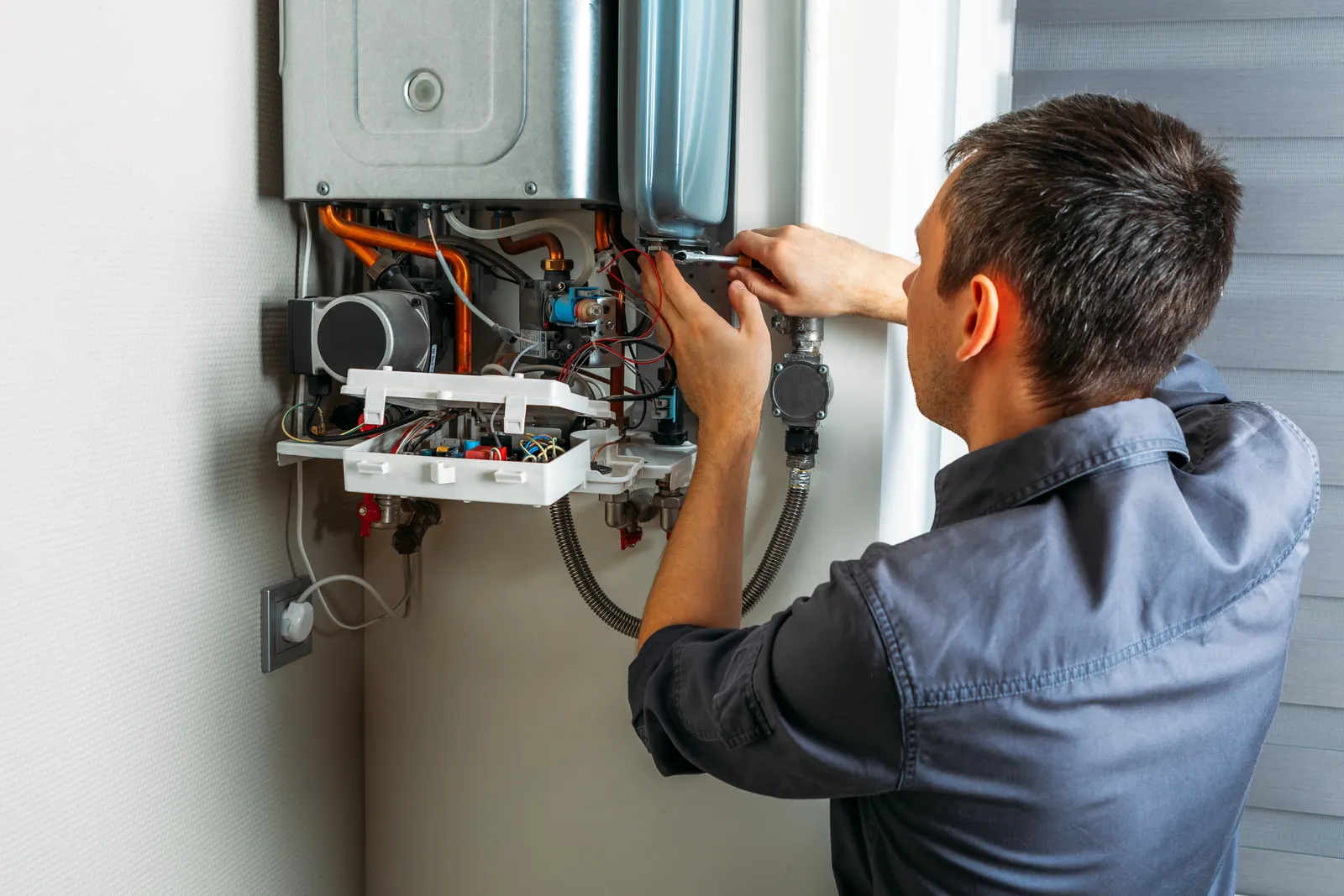
The Decision Isn’t Just About the Unit — It’s About the House
Every water heater comparison online talks about the units themselves, but the honest answer depends more on what’s already installed in the house than on which technology is theoretically better. The existing gas line size, the venting path, the electrical panel capacity, and the household’s actual hot-water usage pattern all narrow the decision before cost or efficiency even enter the conversation. A plumber sizing a replacement should walk all of this before quoting either option. If this sounds familiar, our piece on what drives water heater replacement cost is worth a read.
Upfront Cost and Install Complexity
A standard tank replacement is generally the least expensive and fastest option when the existing gas line, venting, and space are already set up for one — it’s often a same-day swap. A tankless retrofit costs more upfront, and that gap widens if the existing gas line needs to be upsized to support the unit’s higher BTU demand, or if the venting path has to be rerouted since tankless units require dedicated venting rather than sharing a flue the way some atmospheric tanks do. A hybrid heat-pump tank sits in between on cost but needs air space around it to draw heat from, which rules it out for small, tightly enclosed closets.
Hot Water Capacity: Where Tankless Actually Wins
This is the most common reason households switch. A tank has a finite reservoir — run a shower, a dishwasher, and a load of laundry back to back and a smaller tank runs cold before everyone’s done. A correctly sized tankless unit doesn’t have that ceiling; it heats water on demand for as long as a tap is open, which matters most for larger households or homes that regularly have overlapping hot water demands. For a smaller household with staggered usage, this advantage matters less in practice than it does on paper.
Hard Water Changes the Maintenance Math
Central Texas’s water hardness varies significantly by city and even by neighborhood, but wherever it’s on the harder end, it changes how each option ages. A tank handles scale by accumulating sediment at the bottom, which an annual flush clears out — skip that maintenance and the tank scales up, loses efficiency, and fails early. A tankless unit is actually more sensitive to scale, not less: its heat exchanger has narrow passages that mineral buildup can choke off, and manufacturers require an annual descaling flush to keep the warranty valid. Skipping that maintenance is the single most common reason a tankless unit falls short of its rated twenty-year lifespan. On the hardest water in the region, pairing either option with a whole-house softener meaningfully extends its service life.
Longevity: The Real Numbers, Not the Brochure Numbers
A tank’s rated lifespan is typically 8–12 years, but that number swings hard based on maintenance and water hardness — a neglected tank on hard water can fail in five to seven years, while a flushed, anode-maintained tank on the same water can reach twelve to fifteen. Tankless units are rated around 20 years, but that number assumes the annual descale actually happens; skip it consistently and a tankless unit can need exchanger service well before that mark. Neither number is guaranteed — both are ranges that maintenance and water quality push in either direction.
Gas, Electric, or Hybrid — Independent of Tank vs. Tankless
Fuel type is a separate decision layered on top of tank-vs-tankless. Gas units of either type are the cheapest to run and recover fastest but need proper venting and an adequate gas line. Electric tank units need no venting but recover more slowly and cost more to run in most of Texas. Hybrid heat-pump electric tanks are the most efficient to operate but need surrounding air space and periodic filter maintenance, and they work best in a roomier garage rather than a tight closet.
So Which One Actually Fits?
A straightforward tank replacement usually makes sense for a household with typical, staggered hot water usage, an existing gas line and venting already in place, and a preference for the lower upfront cost. A tankless conversion tends to make more sense for larger households that regularly run multiple hot water draws at once, homes where the existing gas line can support the unit without major modification, and homeowners willing to keep up with the annual descale that hard water demands. Neither is a wrong answer in isolation — the fit depends on the specific house and household, which is exactly what a plumber should assess before quoting either option.
Get the Right Size Recommendation for Your House
Get connected to a licensed local plumber for water heater replacement — the dispatch line runs 24/7, the call is free, and the plumber checks your gas line, venting, and household demand before recommending tank, tankless, or hybrid. For tankless-specific sizing details, see the Austin tankless water heater installation guide.
Dealing with a plumbing problem right now?
📞 Call now — get matched with a licensed local plumber: (737) 283-6243
ATX Plumbing Pros is a dispatch and referral service, not a licensed plumbing contractor. All work is performed by independent Texas-licensed (TSBPE) plumbers.
Frequently Asked Questions
Is tankless actually cheaper in the long run?
It depends on gas prices, usage patterns, and how consistently the annual descale gets done. Tankless units use less energy overall since they’re not maintaining a standing reservoir of hot water around the clock, but the higher upfront install cost — especially if a gas line upsize is needed — means the payback period is measured in years, not months.
Can I put a tankless unit in the exact same spot as my old tank?
Sometimes, but not always. Tankless units need dedicated venting that a tank’s shared flue often can’t provide, so the available venting path matters as much as the floor or wall space the old tank occupied.
How often does a tankless unit really need descaling?
Annually is the standard recommendation on hard water, and it’s not optional if you want the unit to hit its rated lifespan — skipping it is the most common reason a tankless heat exchanger needs service years before its twenty-year rating.
Will a whole-house softener help either option last longer?
Yes, meaningfully, on the harder end of the local water supply. A softener reduces the scale buildup that shortens both tank and tankless lifespans, and it’s commonly installed alongside a replacement in the hardest-water parts of Central Texas.
Does switching to tankless require electrical work?
Most gas tankless units need only a standard outlet for the control board and ignition, but some models and all-electric tankless units need a dedicated circuit, which may mean panel capacity has to be checked before installation.
Local Geological, Water-Hardness & TSBPE Code Benchmarks: Austin, TX
| Austin Plumbing Engineering Factor | Austin, TX (Greater Austin & Hill Country) Field Specification |
|---|---|
| Sub-Slab Geology & Soil Movement | Balcones Escarpment split: fractured Edwards limestone west of Mopac vs. expansive Houston Black clay east/south |
| Local Water Hardness & Anode Impact | Austin Water / Edwards & Colorado River blend (200–300 mg/L CaCO₃; up to 360+ mg/L on Hill Country wells) — depletes standard magnesium anode rods in 3–4 yrs |
| Dominant Neighborhood Pipe Cohort | Pre-1985 galvanized/cast-iron bungalows, 1985–2002 copper slabs, and 2005+ two-story PEX/CPVC tracts |
| Leading Local Dispatch Triggers | Limestone sediment water heater failures, clay-shift slab leaks, PRV spikes & live-oak root sewer clogs |
| Texas Licensing & Municipal Permit Rule | TSBPE-Licensed Master Plumber required; City of Austin permits mandatory for water heaters, repipes & sewer/gas lines |
| Typical Greater Austin Market Ranges | $175–$450 (Drain/Valve/PRV Service) | $1,650–$3,800 (Permitted Tank/Tankless Swap) | $2,200–$6,500+ (Slab Reroute/Sewer) — Call (737) 283-6243 |
How much does a plumber cost in Austin, TX?
In Austin, TX, standard plumbing repairs such as faucet cartridges, toilet rebuilds, PRV swaps, and single-drain snaking typically range from $175 to $450. Permitted 50-gallon tank water heater replacements average $1,650 to $2,900, while electronic slab leak detection and overhead PEX reroutes range from $1,800 to $4,800+.
Do you need a permit to replace a water heater in Austin?
Yes, the City of Austin and surrounding Central Texas municipalities require a residential plumbing permit and final inspection for any tank or tankless water heater replacement in Austin, TX. Code compliance requires a thermal expansion tank, a full-size T&P discharge line, a drain pan, and a gas sediment trap.
Why do slab leaks happen so often in Austin, TX?
Slab leaks in Austin, TX are driven by two local factors: expansive Houston Black clay that swells and shrinks 3 to 6 inches seasonally beneath concrete slabs, and mineral-heavy Edwards Aquifer water (200 to 300+ mg/L CaCO₃) that accelerates pinhole corrosion inside buried copper hot-water loops.
Priority Austin Plumbing, Water Heater & Slab Leak Dispatch Hubs
Need same-day or 24/7 service from an independent TSBPE-licensed Master Plumber? Connect directly with our primary hubs for 24/7 emergency plumber in Austin, TX, water heater replacement in Austin, TX, slab leak detection in Austin, TX, and drain cleaning & hydro-jetting in Austin, TX.
Compare local permit and soil requirements in our City of Austin water heater permit guide, Houston Black clay slab leak guide, and neighborhood pages for South Austin (78704/78745), Circle C Ranch, Round Rock, and Cedar Park.
Frequently Asked Questions: Tank vs. Tankless: What Fits an -Area Home? in Austin, TX
How fast can a TSBPE-licensed Master Plumber arrive in Austin, TX?
When you call our 24/7 dispatch line at (737) 283-6243, a live coordinator matches your Austin, TX ZIP code with the nearest available independent TSBPE-licensed Master Plumber. Active burst pipes, main sewer backups, and gas red-tags receive priority emergency routing day or night, while standard repairs typically book same-day.
Does the dispatched plumber provide a written estimate before starting tank vs. tankless: what fits an -area home? in Austin, TX?
Yes, every independent Master Plumber connected through our Austin, TX dispatch line inspects the problem on site first and provides a clear, written line-item estimate before turning a wrench. The dispatch call is completely free, and you are under zero obligation to proceed until you approve the plumber's quote.
Are City of Austin plumbing permits pulled for water heater and sewer replacements in Austin, TX?
Yes, Texas law and the City of Austin Plumbing Code require permits and inspections for water heater replacements, whole-house repipes, gas line pressure tests, and main sewer replacements. Our dispatched TSBPE-licensed Master Plumbers handle permit pulling, thermal expansion tank sizing, and city inspector sign-off as standard practice.
Why does hard water in Austin, TX cause water heaters and fixtures to fail early?
Municipal and well water across Austin, TX draws from limestone aquifers averaging 200 to 340+ mg/L of calcium carbonate hardness. That mineral load consumes standard water heater anode rods in just 3 to 4 years, bakes rock sediment onto tank bottoms, and scales over tankless heat exchangers without annual flushing.
What should I do first if a pipe bursts or my slab is leaking in Austin, TX?
First, shut off your main water valve at the street meter box or exterior garage wall to stop active water flow, and turn off the power or gas burner to your water heater. Next, open the lowest cold faucet to relieve pressure and call (737) 283-6243 for immediate 24/7 dispatch.
⚡ Instant Austin ZIP Availability & 2026 Cost Triage
Dealing with a plumbing problem right now?
📞 Call (737) 283-6243Free 24/7 dispatch line · licensed local plumbers · no obligation