Plumbers in Steiner Ranch — a hillside city of terraces where water pressure is destiny and the fire of 2011 still sorts the housing stock.
Steiner Ranch stair-steps down a Hill Country peninsula between Lake Austin and Lake Travis, and that topography runs its plumbing. Serving homes across hundreds of feet of elevation means pressure zones, booster stations and — at the low end of every zone — static pressure that arrives hot enough to make the PRV on each house a load-bearing appliance. The homes themselves are a 1990s–2010s cohort aging in builder waves: original regulators drifting past their lifespan, first-generation water heaters on second owners, and ’90s-section copper entering pinhole years. And threading through it, the 2011 Labor Day fire’s legacy — rebuilt homes with newer systems beside originals with older ones. The dispatch line matches Steiner Ranch homeowners with independent licensed plumbers who work the hill, the cohort and the distance.
📞 Call (737) 283-6243 — 24/7 Dispatch
One call, no forms, no waiting on callbacks. Describe the problem, and the line matches you with an independent licensed plumber serving Austin — nights, weekends and holidays included. By calling, you consent to be connected with an independent licensed plumbing company serving your area.
Quick answer: Steiner Ranch plumbing runs on pressure: terraced elevation zones put high static psi on the low rows, every house depends on its PRV, and builder-cohort regulators are aging out together — alongside first-generation heaters and ’90s copper. Water comes from WCID 17, not Austin Water. Call (737) 283-6243, 24/7 — the line matches you with an independent TSBPE-licensed plumber who works the hill’s zones and cohorts.
Why is pressure the organizing fact of Steiner Ranch plumbing?
Because gravity bills every terrace differently. Pushing water up a peninsula that climbs hundreds of feet from the lakes requires zone-by-zone boosting, and hydraulics guarantees the arithmetic: to deliver adequate pressure at each zone’s top row, the mains at its bottom row run high — often far above what fixtures are designed to see. Which row you live on decides what the street hands your house, and neighbors a block apart on the slope can gauge 40 psi of difference at their hose bibs. This is normal engineering; it just means the pressure-reducing valve on each house is not an accessory here. It is the appliance standing between the street and everything you own that holds water.
And those PRVs are a cohort. Steiner’s sections built out in waves from the early 1990s through the 2010s, each wave’s builder installing the same valves street by street — components with a 10–15 year working life. The math is public: whole streets’ regulators are past due or coming due together, and a failed-high PRV on a low-terrace lot passes serious street pressure into the house. The symptoms run the classic sequence — banging pipes, whistling fixtures, surging shower temperatures, weeping heater relief valves, hoses and supply lines failing in clusters — and the five-minute hose-bib gauge test reads the truth. On this hill, that test belongs in every service visit and every homeowner’s twice-a-year routine.
Downstream of the pressure story, the usual suspects age faster: water heaters cycling against high inlet pressure, expansion tanks whose bladders quietly fail, and the ’90s sections’ copper — installed in the cohort’s first wave — now deep enough into service life that pinholes cluster where pressure runs hottest. None of it is mysterious. All of it is the hill, doing arithmetic on the housing stock.
What did 2011 leave behind, and what does WCID 17 change?
The Labor Day 2011 wildfire burned into Steiner Ranch and took dozens of homes — and its plumbing legacy is a sorting of the stock. Rebuilt homes carry 2012-plus systems: newer PEX, newer heaters, current-code pressure hardware — effectively a young cohort embedded in an older one, on different maintenance clocks than the originals beside them. For buyers and new owners, build-versus-rebuild history is worth knowing because it predicts what is in the walls; for everyone, the fire’s longer shadow is preparedness culture — households here take shutoff literacy and emergency readiness more seriously than most of Austin, and the plumbing benefits.
The utility picture is its own local fact: Steiner Ranch draws water through Travis County WCID 17, not Austin Water — its own rates, its own conservation stages, its own infrastructure decisions, with supply lifted from the Colorado River system and treated locally. Practical consequences: outage and flushing communications come from the district; drought-stage rules differ from the city’s; and the meter-boundary logic works as everywhere (district to the meter, homeowner past it) but with a smaller, closer utility on the other end. Hill Country water also runs hard — the softener conversation is live here, and heaters unprotected by one wear the scale schedule.
Geography adds the last layer: a peninsula community with essentially one spine road in, at real distance from most of Austin’s plumbing fleet. Response time is a planning input — which makes the prevention list (gauge the pressure, exercise the shutoff, service the heater, know the PRV’s age) worth more here than in neighborhoods ten minutes from everything. The dispatch line’s matching accounts for the distance, pairing Steiner calls with independent licensed plumbers who actually cover the hill.
What does the cohort-aging wave look like house by house?
Like a schedule, if you read it. A mid-’90s section house is likely on its second or third water heater, first or second PRV, and original copper now 30 years old — its watch-list: pinholes at high-pressure runs, expansion tank health, and the regulator’s gauge reading. A mid-2000s house is at the classic first-big-cycle moment: original heater at or past its lifespan (attic installs over living space raise those stakes), original PRV due, original supply hoses past rated life. A 2010s or post-fire rebuild is younger but not maintenance-free: builder-grade components’ first failures, and tankless units — common in the newer stock — on their descale clock in hard Hill Country water.
The neighborly signal works here the way it does in every cohort community: when the same-vintage house three doors down floods an attic or replaces a dead regulator, that is your street’s actuarial table speaking. Proactive replacement on your calendar — a heater at year 11 in October, a PRV at the first drifted reading — costs a fraction of the same component failing on its own schedule, which in attic-heater country means through a ceiling.
And the HOA-and-finish layer shapes execution: consistent exteriors mean exterior work (softener loops, heater relocations, re-routes) navigates community standards; larger lots and irrigation systems mean the Preston-Hollow-style meter-isolation discipline applies when bills jump; and the community’s families-and-commuters rhythm means failures get discovered at 6 p.m. and want same-evening triage. The dispatch line answers around the clock precisely for that arrival pattern — describe the terrace, the section’s vintage and the symptom, and the match is made with the pattern already understood.
Austin service guides — the same network covers Steiner Ranch
Every card below links to a detailed service guide — what the work involves, what drives the effort, and what to check before anyone arrives. The dispatch line covers all of it for Austin.
24/7 Emergency Plumbing
Burst pipes, active leaks, sewage backups — the line answers around the clock and routes you to a licensed plumber on call.
Water Heater Repair
Tank and tankless diagnosis — no hot water, pilot failures, sediment noise, leaking T&P valves.
Drain Cleaning
Snaking, hydro-jetting and camera scoping for kitchen, shower and mainline clogs.
Leak Detection
Acoustic and thermal location of hidden leaks before they become demolition projects.
Slab Leak Detection
Under-slab pinpointing so the plumber opens one spot in the foundation, not five.
Sewer Line Repair
Camera-verified diagnosis, trenchless lining and pipe bursting where the ground allows.
Tankless Water Heaters
Sizing, gas-line checks and descaling schedules matched to local water hardness.
Water Softener Installation
Grain-capacity sizing based on the hardness that actually comes out of local taps.
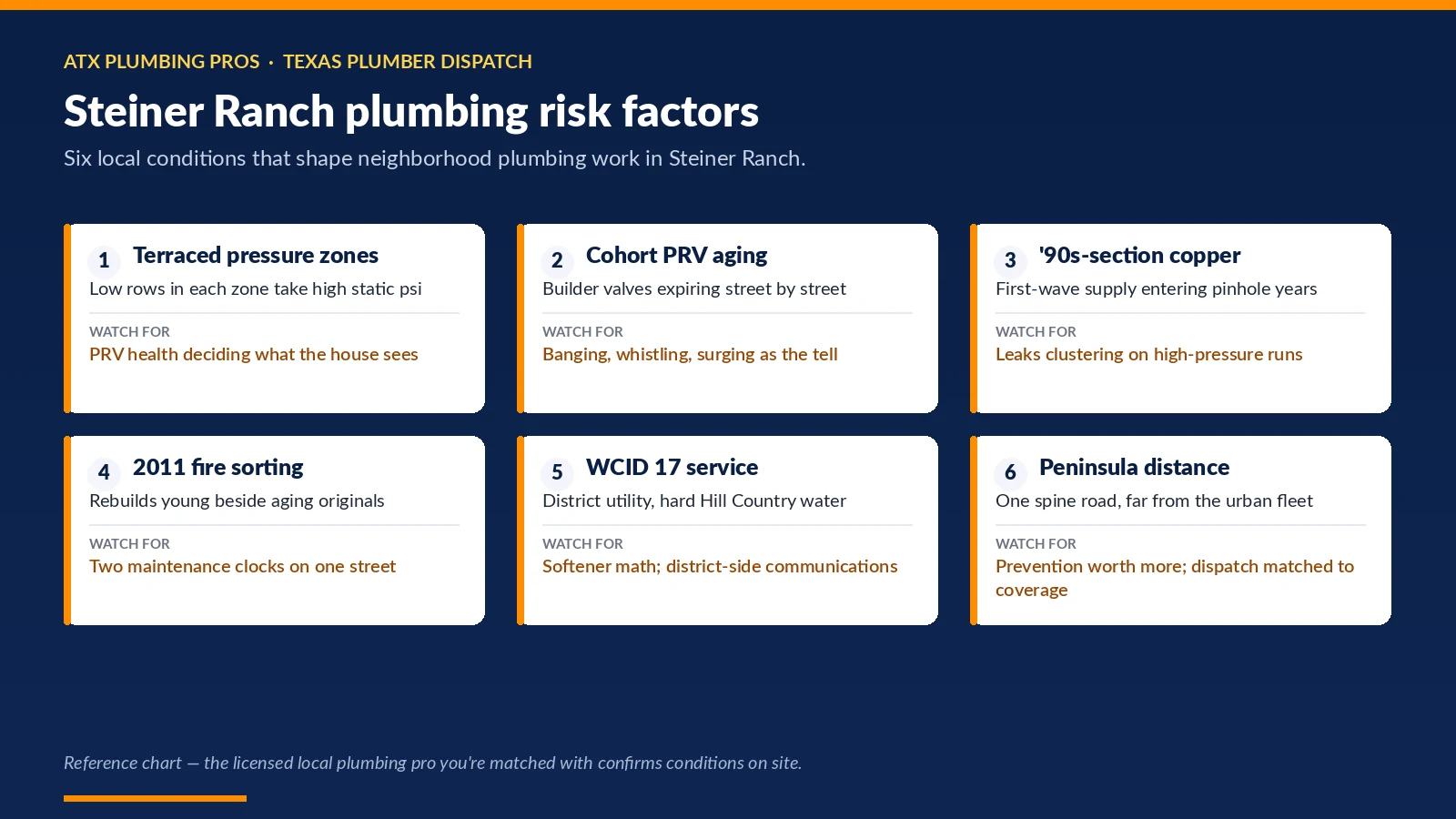
Steiner Ranch plumbing risk factors, mapped
Six local conditions define plumbing on the Steiner peninsula:
| Local factor | What it does to plumbing | What to watch for |
|---|---|---|
| Terraced pressure zones | Low rows in each zone take high static psi | PRV health deciding what the house sees |
| Cohort PRV aging | Builder valves expiring street by street | Banging, whistling, surging as the tell |
| ’90s-section copper | First-wave supply entering pinhole years | Leaks clustering on high-pressure runs |
| 2011 fire sorting | Rebuilds young beside aging originals | Two maintenance clocks on one street |
| WCID 17 service | District utility, hard Hill Country water | Softener math; district-side communications |
| Peninsula distance | One spine road, far from the urban fleet | Prevention worth more; dispatch matched to coverage |
Which Austin areas does the dispatch line cover?
Independent licensed plumbers in the network take dispatch calls across Austin, including:
Steiner Ranch plumbing questions, answered straight
How do I find out what pressure my house is actually getting?
A gauge from any hardware store, screwed onto a hose bib with all water off, reads it in five minutes: roughly 50–75 psi is healthy, over 80 means the PRV has failed or drifted. On Steiner’s terraces the reading varies house to house by elevation, so your neighbor’s number is not yours. Read it twice a year and after any symptom — banging pipes, surging showers — and keep the number; the trend is as informative as the value.
Who supplies my water here — Austin Water?
No — Steiner Ranch is served by Travis County WCID 17, an independent district drawing from the Colorado River system with its own treatment, rates and drought stages. Practical upshots: outage and flushing notices come from the district, conservation rules can differ from Austin’s, and the district’s responsibility ends at your meter. Everything from the meter to and through the house is the homeowner’s, handled by licensed plumbers.
Was my house affected by the 2011 fire, and does it matter for plumbing?
County records and the community’s institutional memory settle the history question quickly. It matters because rebuilt homes carry 2012-plus plumbing — newer materials, current-code pressure hardware — while originals of the same street carry their section’s vintage. The two age on different clocks: a rebuild’s first component cycle is arriving now, while a ’90s original is deep into its second. Knowing which house you own sets the right maintenance calendar.
Why do water heaters seem to die young in this neighborhood?
Three stacked forces: high zone pressure cycling the tank harder (especially where the PRV has drifted and the expansion tank is tired), hard Hill Country water building scale beds that insulate burners and pit tankless exchangers, and cohort installation — whole sections’ heaters hit their statistical endpoint together, so the failures feel epidemic. Pressure managed, water softened and anodes checked, the same heaters serve full lifespans here.
Is response time really a concern this far out?
It is an input, not a crisis — the peninsula’s distance and single spine road mean the fleet is thinner than central Austin’s, and the dispatch line matches accordingly with plumbers who genuinely cover the hill. The rational response is tilting toward prevention: shutoff located and exercised, pressure gauged, heater serviced, PRV dated. Households that run that list convert most would-be emergencies into scheduled appointments — the version of plumbing that never cares about drive time.
More Austin plumbing searches
Start from the Austin city guide for the full local picture, or jump straight to the search that matches your problem.
Shower surging hot-cold, or a same-model heater failing down the street?
Say which section, what vintage and what is happening — on this hill the terrace and the year usually name the problem. The line matches you with an independent TSBPE-licensed plumber who covers Steiner Ranch, 24/7.
Austin Plumbing Pros is a dispatch and referral service, not a licensed plumbing contractor. All work is performed by independent Texas-licensed (TSBPE) plumbers who hold their own license, insurance and bond. Availability varies by area and time of day.