Emergency plumber in Buda — an 1881 rail town wearing a boomburb, where Main Street plumbing and master-planned plumbing fail nothing alike.
Buda holds two towns in one city limit. The original one — the 1881 railroad grid around Main Street, now a celebrated small-town core — runs century-old pier-and-beam houses with galvanized supply, vintage drains and the renovation layers a historic district accumulates. The new one — Sunfield, Whispering Hollow, Garlic Creek and the subdivision belt that multiplied Buda’s population — runs 2000s-to-2020s cohort construction with post-tension slabs, builder-grade components aging in waves, and MUD-district utilities. Between them: Edwards-hard water working everything, Onion Creek’s flood memory shaping the low ground, and a commuter town’s discovery lag. The dispatch line matches Buda households with independent licensed plumbers who work both towns, 24/7.
📞 Call (737) 283-6243 — 24/7 Dispatch
One call, no forms, no waiting on callbacks. Describe the problem, and the line matches you with an independent licensed plumber serving Buda — nights, weekends and holidays included. By calling, you consent to be connected with an independent licensed plumbing company serving your area.
Quick answer: Plumbing emergency in Buda: stop the water first — garage-wall valve or curbside meter box in the subdivisions; exterior wall, crawl-space entry or meter box in the old town — then call (737) 283-6243, answered 24/7. The line matches you with an independent TSBPE-licensed plumber for bursts, heater failures, slab leaks and backups across Buda’s old grid and new belts alike.
How do Buda’s two towns fail differently?
The old grid fails on vintage. Century houses around Main Street carry the classic old-Texas kit — galvanized supply at its endpoint, drains from several plumbing eras, clay or early-iron laterals under mature pecans and live oaks — and pier-and-beam construction that hangs the supply lines in crawl spaces. Their emergencies skew accordingly: crawl-space freeze bursts when a norther finds uninsulated runs, hot-side supply failures as old steel finally opens, root-choked laterals backing up on holiday weekends, and the splice-archaeology surprises that a hundred years of renovations leave behind walls.
The subdivision belt fails on synchrony. Sunfield, Whispering Hollow, Garlic Creek, Shadow Creek and their siblings installed identical heaters, PRVs and hoses phase by phase through the 2000s–2020s, and the earliest phases are now crossing component design life together — the Kyle pattern one town north, running a few years behind it. Post-tension slabs put the reroute logic under most slab leaks; attic and garage heater placements decide whether a tank’s death is a puddle or a ceiling; and one street’s failure forecasts the block’s season.
Both towns share the water. Buda draws Edwards-corridor hardness — comfortably in the ‘very hard’ range — and the chemistry treats a 1920 bungalow and a 2015 two-story identically: scale beds shortening heater lives, cartridges crusting, and the emergency-critical one, shutoff valves seizing in place between rare uses. Whatever else divides Buda’s housing stock, the twice-a-year valve-exercising habit and the softener conversation belong to all of it.
What does Onion Creek’s flood memory mean for plumbing?
Respect for the low ground. The Onion Creek and Garlic Creek drainages taught this corridor hard lessons in 2013 and 2015 — flood events that reshaped floodplain maps and building practice up and down the watershed — and the plumbing consequences outlast the headlines. Homes in and near the mapped low areas carry elevated equipment where rebuilt or retrofitted, and the ones that do not should: a water heater or softener on the garage floor of a flood-adjacent lot is inventory waiting for the next event, and elevating it is a modest project on a calm Saturday.
Backflow is the second lesson. When creeks rise and the wastewater system surcharges, low-lying homes become the neighborhood’s pressure-relief point — which is what backwater valves exist to prevent. On blocks with flood history, a backwater valve on the lateral is the difference between a storm being weather and being remediation; plumbers who work the corridor treat it as standard equipment on qualifying lots. Post-storm, the checklist runs: pressure-test if service was interrupted, relight and inspect gas appliances professionally if water reached them, and camera any lateral that took inundation — silt and debris in a young line shorten its future quietly.
And storm season pairs with freeze season on the calendar of Buda emergencies: the same crawl spaces that flood-adjacent old-town houses keep ventilated for moisture are the ones a February norther turns into burst factories. The old town’s winter list — insulate crawl runs, close vents, drip exterior-wall faucets, know the shutoff — is the same one every historic Texas grid learns; Buda’s edition simply adds ‘check it against the creek forecast too.’
What should Buda households do before and during the emergency?
Before: learn your house’s version of the shutoff. Subdivision builds put the main valve in the garage at the front-wall supply entry (often by the softener loop) with the curbside meter box as fallback; old-town houses hide it at exterior walls, crawl-space entries or only at the meter — and in either town, Buda’s hard water means a valve unexercised for years may not turn when wet and panicked hands finally try. Two minutes twice a year keeps it honest. Add the cohort-calibrated list on the new side (heater and PRV ages, braided hoses, pressure reading) and the vintage list on the old side (crawl insulation, lateral camera baseline, splice inspection when walls open).
During: sequence beats speed. Water off first — every minute at pressure is gallons into the structure. Pressure relieved at a low faucet. Power cut to any room where water reached outlets; gas appliances left alone until professionally checked if water touched them. Sewage events: stop using every fixture and keep people off contaminated flooring. Then documentation — photos before cleanup, the meter reading, when it started if known — because insurance conversations reward evidence and punish tidiness. All of it is coachable in real time: the dispatch call walks households through stabilization while the match is made.
And the call itself works better with three facts: what is failing, where the house is (old grid, which subdivision, near the creek), and the build era. Buda’s split personality makes those answers unusually predictive — a 2006 Sunfield two-story with a ceiling stain and a 1925 Main Street bungalow with a crawl-space hiss are different dispatches, and the line matches accordingly: independent TSBPE-licensed plumbers who work the corridor’s cohort stock, its century stock, or both. 24/7, with the first ten minutes coached free on the phone.
What else does the line cover for Buda homes?
Every card below links to a detailed service guide — what the work involves, what drives the effort, and what to check before anyone arrives. The dispatch line covers all of it for Buda.
24/7 Emergency Plumbing
Burst pipes, active leaks, sewage backups — the line answers around the clock and routes you to a licensed plumber on call.
Water Heater Repair
Tank and tankless diagnosis — no hot water, pilot failures, sediment noise, leaking T&P valves.
Drain Cleaning
Snaking, hydro-jetting and camera scoping for kitchen, shower and mainline clogs.
Leak Detection
Acoustic and thermal location of hidden leaks before they become demolition projects.
Slab Leak Detection
Under-slab pinpointing so the plumber opens one spot in the foundation, not five.
Sewer Line Repair
Camera-verified diagnosis, trenchless lining and pipe bursting where the ground allows.
Tankless Water Heaters
Sizing, gas-line checks and descaling schedules matched to local water hardness.
Water Softener Installation
Grain-capacity sizing based on the hardness that actually comes out of local taps.
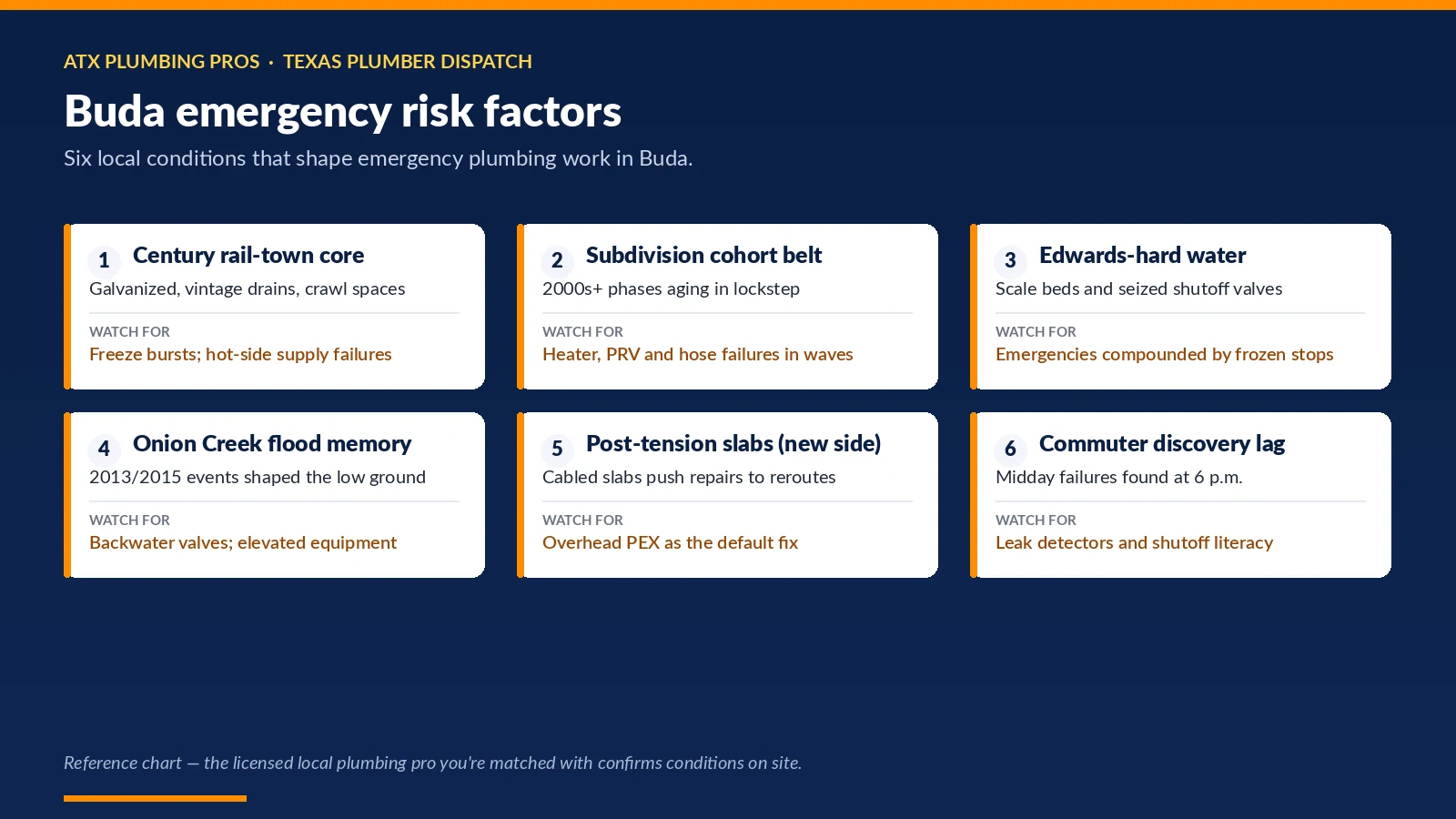
Buda emergency risk factors, mapped
Six local conditions shape Buda’s emergency-call pattern:
| Local factor | What it does to plumbing | What to watch for |
|---|---|---|
| Century rail-town core | Galvanized, vintage drains, crawl spaces | Freeze bursts; hot-side supply failures |
| Subdivision cohort belt | 2000s+ phases aging in lockstep | Heater, PRV and hose failures in waves |
| Edwards-hard water | Scale beds and seized shutoff valves | Emergencies compounded by frozen stops |
| Onion Creek flood memory | 2013/2015 events shaped the low ground | Backwater valves; elevated equipment |
| Post-tension slabs (new side) | Cabled slabs push repairs to reroutes | Overhead PEX as the default fix |
| Commuter discovery lag | Midday failures found at 6 p.m. | Leak detectors and shutoff literacy |
Which Buda areas does the dispatch line cover?
Independent licensed plumbers in the network take dispatch calls across Buda, including:
Buda emergency questions, answered straight
Where is the shutoff likely to be in my Buda house?
New-side subdivisions: in the garage where the supply enters the front wall — often beside the softener loop — with the curbside meter box as universal fallback. Old-town houses: check exterior walls near the hose bibs, the crawl-space entry, and failing those, the meter box at the street. In both cases, verify it turns before you need it: Buda’s hard water seizes idle valves, and the meter-box stop needs a meter key or wrench you should own in advance.
Our Sunfield house is hitting 15 years old. What is about to fail?
The original equipment, roughly in this order: water heater (design life reached — and if it is an attic or upstairs-closet install, its failure mode involves ceilings), pressure regulator (drifting high — gauge a hose bib and read the truth), and the builder-grade rubber supply hoses at washer, toilets and sinks (swap for braided stainless preemptively). Your street shares your schedule — treat each neighbor’s failure as your free warning.
Does the creek flooding history actually affect my plumbing decisions?
If you are in or near the mapped low ground, concretely: elevate garage-floor equipment (heater, softener) above plausible water lines, discuss a backwater valve on the lateral so a surcharged system cannot flow backward into the house, and after any inundation event, camera the lateral and professionally check gas appliances water may have reached. Outside the flood-adjacent blocks, the memory matters mainly as respect for where the water goes when the corridor gets one of its big rains.
The old house’s pipes knock and the hot tap is feeble. Emergency or not?
Not tonight — but it is the endgame announcement. Feeble hot flow is century galvanized closing up (hot side corrodes first); knocking suggests pressure or securing issues layered on top. The risk is that end-stage galvanized fails as a burst, often during a freeze, in a crawl space that soaks quietly. Treat it as a planning emergency: a walkthrough, a pressure reading, and a staged repipe conversation on your calendar rather than the pipe’s.
Can Buda actually get night and weekend coverage, or does everything wait for Austin?
The line exists to answer exactly that: it matches against real availability across the corridor — Buda, Kyle and the south-Austin fringe — around the clock, with active-water emergencies first in the queue. Describe the situation, the neighborhood and whether the water is stopped; genuine emergencies dispatch now, stabilized ones may sensibly book for morning. Either way the stabilization coaching starts on the call, not on arrival.
More Buda plumbing searches
Start from the Buda city guide for the full local picture, or jump straight to the search that matches your problem.
Crawl-space hiss on Main Street, or a Sunfield ceiling going soft?
Stop the water, then give the line the three facts — what is failing, which Buda, what era — and the match is made with the pattern already read. Independent TSBPE-licensed plumbers, 24/7, both towns covered.
Austin Plumbing Pros is a dispatch and referral service, not a licensed plumbing contractor. All work is performed by independent Texas-licensed (TSBPE) plumbers who hold their own license, insurance and bond. Availability varies by area and time of day.