Plumbers in Hyde Park — Austin’s 1891 streetcar suburb, where a moontower lights bungalows plumbed in three different centuries.
Hyde Park was Austin’s first planned suburb — laid out in 1891 at the end of a streetcar line, now a local historic district where Victorians and 1920s–30s bungalows sit under heritage pecans and one of the city’s surviving moonlight towers. The plumbing tells the whole timeline: original galvanized threaded through plaster walls, clay-tile laterals that century-old root systems have long since mapped, mid-century copper from the first renovation wave, and PEX from the last one — often all four in a single house. Pier-and-beam construction keeps most of it reachable, the historic district shapes how exterior work gets done, and the 2021 freeze found every uninsulated crawl space in the neighborhood at once. The dispatch line matches Hyde Park homeowners with independent licensed plumbers who read old houses fluently.
📞 Call (737) 283-6243 — 24/7 Dispatch
One call, no forms, no waiting on callbacks. Describe the problem, and the line matches you with an independent licensed plumber serving Austin — nights, weekends and holidays included. By calling, you consent to be connected with an independent licensed plumbing company serving your area.
Quick answer: Hyde Park’s plumbing agenda: century-old galvanized reaching its endpoint, clay laterals under heritage pecans on a root clock, renovation-era splices from every decade, crawl-space freeze exposure — and historic-district review shaping visible exterior work. Call (737) 283-6243, 24/7 — the line matches you with an independent TSBPE-licensed plumber who works Austin’s oldest housing stock every week.
What is actually in the walls of a Hyde Park bungalow?
Layers — because these houses have been renovated for a hundred years. The base stratum is original: galvanized steel supply lines snaked through plaster-and-lath walls, now anywhere from 90 to 130 years old and deep into the internal rust that ends in weak hot taps, discolored first draws and pressure that folds when a second fixture opens. Above it, each renovation era left its layer — 1960s–70s copper in the kitchens and baths that got redone first, 1990s recirculation experiments, 2000s-to-now PEX wherever recent remodels reached. The transitions between eras, not the pipes themselves, are the reliable weak points: dissimilar-metal couplings corroding galvanically behind plaster nobody wants to open.
Pier-and-beam construction is the neighborhood’s mercy. Unlike slab-era Austin, a Hyde Park house exposes most of its supply and drain runs in the crawl space — which makes diagnosis honest (a plumber can see and touch the system) and repipes comparatively humane: whole-house replacements here route through crawl and attic with far less wall surgery than any slab neighborhood endures. The same access explains the local repair culture’s archaeology: opening one crawl-space panel reads the house’s whole renovation history in pipe.
Plaster is the countervailing tax. Where wall access is unavoidable — supply drops, vent stacks, the bathroom wet wall — historic plaster costs more to open and close than drywall, and finishes in a district-protected Victorian are not patch-and-forget surfaces. Experienced old-house plumbers plan access like surgeons: through closets, from the crawl, behind cabinetry — anywhere the scar will not show. It is a skill the neighborhood quietly prices, and the difference between crews who have it and crews who do not is visible on the walls.
What do the pecans, the district and the freeze each demand?
The pecans and heritage oaks own the ground. Hyde Park’s canopy is a century old, and so are its clay-tile laterals — short sections, jointed every few feet, laid exactly where the roots forage. The result is Austin’s classic root-intrusion cycle at its most mature: joints mapped by generations of root systems, cabling cycles that shorten each round, and the camera as arbiter of whether a lateral is a maintenance case or a replacement case. Digging decisions carry extra weight here — trenching under a protected heritage tree draws the city’s tree ordinance into the project — which pushes sewer work toward camera-guided spot repairs, lining where the host pipe qualifies, and boring that respects critical root zones.
The historic district shapes the visible envelope. Interior plumbing is untouched by preservation review, but exterior changes on contributing structures — a tankless unit hung on a street-facing wall, new venting through visible rooflines, relocated meters — can require historic review depending on placement. The practical craft is siting: equipment tucked to alleys and rear walls, penetrations kept off the streetscape, and paperwork filed correctly the first time. Plumbers who work Hyde Park, Clarksville and Travis Heights as a circuit keep the review thresholds in their heads.
And February 2021 wrote the freeze chapter: crawl spaces that had never met minus-degrees wind chill delivered burst galvanized and split copper across the neighborhood at once, and the repair wave ran for months. The lessons stuck — insulated crawl runs, closed winter vents, dripped faucets on exterior walls, and shutoff literacy (in this stock, often a curb-box meter valve whose location tenants and even owners had never learned). Houses that took the 2021 list seriously rode out every snap since; the ones that did not are still funding January work.
How does old-house plumbing work actually get sequenced here?
Around the renovation calendar, ideally. Hyde Park houses change hands and get lovingly redone on a steady rhythm, and every remodel is the discounted moment for systems work: the kitchen renovation that opens the wet wall is the cheap chance to retire the last galvanized run it contains; the foundation-leveling visit (pier-and-beam houses get releveled too) is the moment to correct drain slope while crews are already under the house; the bathroom addition is when the century-old 3-inch stack gets upsized. The neighborhood’s well-plumbed houses got that way across two or three renovation cycles, each one retiring a stratum.
Between renovations, stewardship is scheduled rather than reactive: a camera baseline on the lateral (and a root-cutting calendar set by what it shows), the hose-bib pressure reading twice a year, water heater service on the anode-and-flush rhythm Austin’s moderately hard water rewards, and a crawl-space walk each fall before the first freeze — checking insulation, looking for the weeps that old joints develop, confirming the shutoff turns. None of it is exotic; all of it is cheaper than any single failure it prevents.
The rental layer adds its own cadence. Hyde Park’s proximity to UT seeds the blocks with long-held rental bungalows on the same academic calendar as every campus neighborhood — move-in surges, winter-break vacancy risk, landlord-authorization workflows — layered onto housing a century older than the typical student rental. The dispatch line handles that triangle daily: tenant report, owner approval, independent licensed plumber dispatched with the old-house context already in the notes.
Austin service guides — the same network covers Hyde Park
Every card below links to a detailed service guide — what the work involves, what drives the effort, and what to check before anyone arrives. The dispatch line covers all of it for Austin.
24/7 Emergency Plumbing
Burst pipes, active leaks, sewage backups — the line answers around the clock and routes you to a licensed plumber on call.
Water Heater Repair
Tank and tankless diagnosis — no hot water, pilot failures, sediment noise, leaking T&P valves.
Drain Cleaning
Snaking, hydro-jetting and camera scoping for kitchen, shower and mainline clogs.
Leak Detection
Acoustic and thermal location of hidden leaks before they become demolition projects.
Slab Leak Detection
Under-slab pinpointing so the plumber opens one spot in the foundation, not five.
Sewer Line Repair
Camera-verified diagnosis, trenchless lining and pipe bursting where the ground allows.
Tankless Water Heaters
Sizing, gas-line checks and descaling schedules matched to local water hardness.
Water Softener Installation
Grain-capacity sizing based on the hardness that actually comes out of local taps.
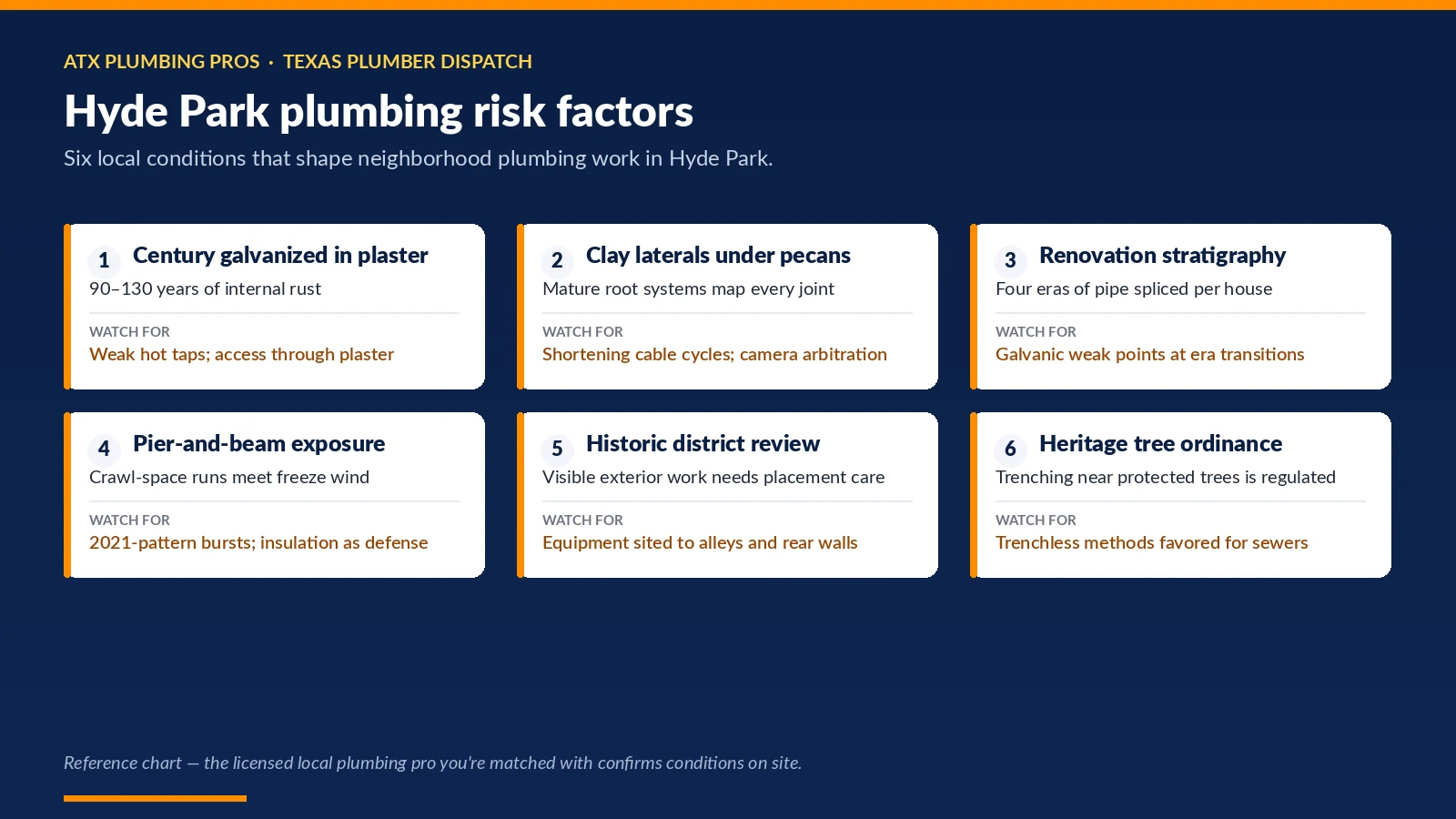
Hyde Park plumbing risk factors, mapped
Six local conditions define plumbing in Austin’s first suburb:
| Local factor | What it does to plumbing | What to watch for |
|---|---|---|
| Century galvanized in plaster | 90–130 years of internal rust | Weak hot taps; access through plaster |
| Clay laterals under pecans | Mature root systems map every joint | Shortening cable cycles; camera arbitration |
| Renovation stratigraphy | Four eras of pipe spliced per house | Galvanic weak points at era transitions |
| Pier-and-beam exposure | Crawl-space runs meet freeze wind | 2021-pattern bursts; insulation as defense |
| Historic district review | Visible exterior work needs placement care | Equipment sited to alleys and rear walls |
| Heritage tree ordinance | Trenching near protected trees is regulated | Trenchless methods favored for sewers |
Which Austin areas does the dispatch line cover?
Independent licensed plumbers in the network take dispatch calls across Austin, including:
Hyde Park plumbing questions, answered straight
Does the historic district restrict plumbing work on my house?
Interior work, no — repipes, heater swaps and drain work inside proceed normally. Exterior changes on contributing structures can trigger review depending on visibility and placement: streetscape-facing equipment, visible vent penetrations, that class of change. The working answer is siting — tankless units and meters to rear and alley walls, penetrations off the street elevation — and a plumber who knows the review thresholds files once and correctly.
Is a repipe less disruptive here than people fear?
Generally yes, thanks to pier-and-beam. Most supply runs route through crawl space and attic, so a whole-house repipe reaches the majority of the system without opening plaster — wall work concentrates at fixture drops and the wet wall. Expect a few days’ arc with water on each night, and insist on the old-house access plan: through closets and cabinetry where possible, with plaster patching by someone who has met plaster before.
How do I know if my sewer line needs replacing or just maintenance?
The camera settles it. Clay laterals with sound structure but rooted joints are maintenance cases — proper cutting, then a schedule set by observed regrowth. Displaced joints, crushed sections or systemic failure argue for repair: spot excavation, lining where the host pipe qualifies, or replacement. Under Hyde Park’s protected canopy, that footage also decides dig-versus-trenchless — which makes the camera pass a tree-preservation document as much as a plumbing one.
What freeze prep does a 1920s bungalow actually need?
The crawl space is the whole game: insulate accessible supply runs, close foundation vents for winter, drip faucets on exterior walls during hard freezes, and open cabinet doors on plumbing walls. Add shutoff literacy — find the valve (often at the curb meter box), confirm it turns, teach the household. The 2021 freeze burst pipes across this neighborhood in a night; every subsequent snap has sorted houses precisely by who did this list.
The house still has some galvanized. Replace it all now or wait?
Strategy beats urgency. Galvanized at this age is on borrowed time, but the sensible sequencing is opportunistic: retire whatever runs each renovation opens, prioritize the hot side (it fails first) and any run showing weeps, and plan the final stages rather than reacting to them. What to avoid is repeated spot-patching of a system whose endpoint is visible — every splice into century-old steel is money spent postponing the same conversation.
More Austin plumbing searches
Start from the Austin city guide for the full local picture, or jump straight to the search that matches your problem.
Rusty first draw, or a remodel about to open century-old walls?
Describe the house — vintage, what era’s work you know about, what is failing — and the line matches you with an independent TSBPE-licensed plumber who works Austin’s oldest stock, respects plaster and pecans alike, and knows the district’s thresholds. 24/7.
Austin Plumbing Pros is a dispatch and referral service, not a licensed plumbing contractor. All work is performed by independent Texas-licensed (TSBPE) plumbers who hold their own license, insurance and bond. Availability varies by area and time of day.