Emergency plumber in Kyle — a town that quadrupled in twenty years, whose first big build-wave is now out of warranty and into failure years.
Kyle grew from a rail-stop town of a few thousand into one of the I-35 corridor’s defining boomburbs — fifty-thousand-plus residents, subdivision after subdivision poured in waves from the early 2000s onward. That growth curve is now a maintenance curve. The first waves — Plum Creek’s early phases, Steeplechase, the neighborhoods that led the boom — are two decades old: past builder warranty, past component design life, into the years when original water heaters, PRVs and supply hoses fail in cohort rhythm. Add Edwards-hard water working every appliance, corridor pressure zones, and a commuter town’s 6 p.m. discovery schedule, and Kyle’s emergencies follow patterns the dispatch line sees nightly. It matches Kyle households with independent licensed plumbers around the clock.
📞 Call (737) 283-6243 — 24/7 Dispatch
One call, no forms, no waiting on callbacks. Describe the problem, and the line matches you with an independent licensed plumber serving Kyle — nights, weekends and holidays included. By calling, you consent to be connected with an independent licensed plumbing company serving your area.
Quick answer: Plumbing emergency in Kyle: kill the water first — main valve typically in the garage near the front wall or at the curbside meter box — then call (737) 283-6243, answered 24/7. The line matches you with an independent TSBPE-licensed plumber for burst lines, water heater failures, slab leaks and backups across Kyle’s subdivisions, nights and weekends included.
What is failing in Kyle right now, and why in waves?
The 2000s cohort is hitting its dates. A subdivision poured in 2004 received hundreds of identical water heaters, pressure regulators and builder-grade supply hoses in one season — components with ten-to-fifteen-year design lives that are now years past due. The failures arrive the way they were installed: in waves. One street’s first attic-adjacent heater failure or garage-tank release forecasts its neighbors’; one burst washing-machine hose is a model-year warning for every laundry room on the block. Kyle households asking why everything seems to break at once are watching installation synchrony play out as failure synchrony.
Water chemistry accelerates the schedule. Kyle draws hard Edwards-corridor water, and two decades of 15-plus grains have built scale beds in original tanks (rumbling, slow recovery, early death), crusted fixture cartridges, and — the emergency-relevant one — seized shutoff valves: the angle stop under the toilet that has not turned since 2005 chooses the flood moment to prove it. Exercising the main and fixture stops twice a year is the free counter; discovering them frozen mid-emergency is the expensive one.
Pressure completes the triad. The corridor’s pressure zones run generous to reach growing subdivisions, every house shipped with a PRV, and those PRVs are the same age as everything else — drifting and failing high across the early phases. The symptoms cascade quietly (banging pipes, whistling toilets, surging showers, weeping heater relief valves) until a hose or fitting somewhere becomes the visible emergency. The five-minute hose-bib gauge reading — healthy is roughly 50–75 psi — is the single highest-yield check a Kyle homeowner can run this weekend.
How do Kyle’s emergencies actually unfold — and what stops them early?
On a commuter clock. Kyle works in Austin and San Marcos, which means failures that start mid-morning run unwitnessed until 6 p.m. — the slab leak warming a floor all day, the supply hose spraying a laundry room since noon, the water heater weeping into its pan since breakfast. The arithmetic of damage is time, so the counters are about compressing discovery: smart leak detectors under heaters and behind washers (cheap, loud, increasingly standard in newer phases), a glance at the meter’s low-flow dial when the bill looks odd, and every adult knowing the main shutoff’s location before the wet night it matters.
The shutoff itself deserves specifics: in most Kyle-era construction the main valve sits in the garage where the supply enters through the front wall — often near the softener loop — with the fallback at the curbside meter box, opened with a meter key or long screwdriver and closed with a wrench on the city stop. Post-tension slabs run under most of the newer stock, which means slab leaks here follow the reroute logic (abandon the run, go overhead) rather than slab-cutting; knowing that in advance makes the 2 a.m. conversation shorter.
And sewage backups keep their universal habits: they arrive on weekends and holidays when houses run full, they announce themselves at the lowest drain first, and the correct response is to stop using every fixture immediately — each upstairs flush arrives downstairs. New-growth Kyle adds a specific cause worth naming: construction-era debris and grading issues in young laterals, which produce backups in houses too young to have earned them. A camera pass settles whether the line is dirty, damaged or was never quite right — and on a house still near its warranty years, that footage is leverage.
What belongs on a Kyle household’s prevention list?
The cohort checklist, calibrated to the house’s build year. At fifteen-plus years: assume the original heater and PRV are past due rather than aging — proactive replacement on your calendar runs a fraction of the failure version through a ceiling or hallway; swap builder-grade rubber supply hoses for braided stainless everywhere they serve washers, toilets and sinks; and gauge the pressure. At ten years: heater anode and flush service (hard water halves the grace period), pressure reading, and the valve-exercising habit. Newer phases: locate the shutoff, verify the heater pan drains somewhere real, and put the leak detectors in before the first anniversary.
Hard-water management is Kyle’s multiplier: a properly sized softener removes the chemistry that is simultaneously killing the heater, crusting the fixtures and seizing the valves — in this corridor it is less an upgrade than a counterweight. Houses that added one early wear visibly better at the fifteen-year mark; houses without one fund the difference in appliances. Pair it with the annual heater service and the pressure reading and most of the cohort’s failure calendar moves from ‘emergency’ to ‘scheduled.’
And use the neighborhood’s synchrony as the early-warning system it is: when the same-vintage house three doors down replaces a dead heater or floods from a PRV-driven hose burst, that is your street’s actuarial table speaking directly to you. The dispatch line hears those waves citywide in real time — describe your subdivision and build year when you call, and the pattern-matching starts before the plumber does. In cohort towns, the 2 a.m. emergency is often optional; Kyle is a cohort town from the ground up.
What else does the line cover for Kyle homes?
Every card below links to a detailed service guide — what the work involves, what drives the effort, and what to check before anyone arrives. The dispatch line covers all of it for Kyle.
24/7 Emergency Plumbing
Burst pipes, active leaks, sewage backups — the line answers around the clock and routes you to a licensed plumber on call.
Water Heater Repair
Tank and tankless diagnosis — no hot water, pilot failures, sediment noise, leaking T&P valves.
Drain Cleaning
Snaking, hydro-jetting and camera scoping for kitchen, shower and mainline clogs.
Leak Detection
Acoustic and thermal location of hidden leaks before they become demolition projects.
Slab Leak Detection
Under-slab pinpointing so the plumber opens one spot in the foundation, not five.
Sewer Line Repair
Camera-verified diagnosis, trenchless lining and pipe bursting where the ground allows.
Tankless Water Heaters
Sizing, gas-line checks and descaling schedules matched to local water hardness.
Water Softener Installation
Grain-capacity sizing based on the hardness that actually comes out of local taps.
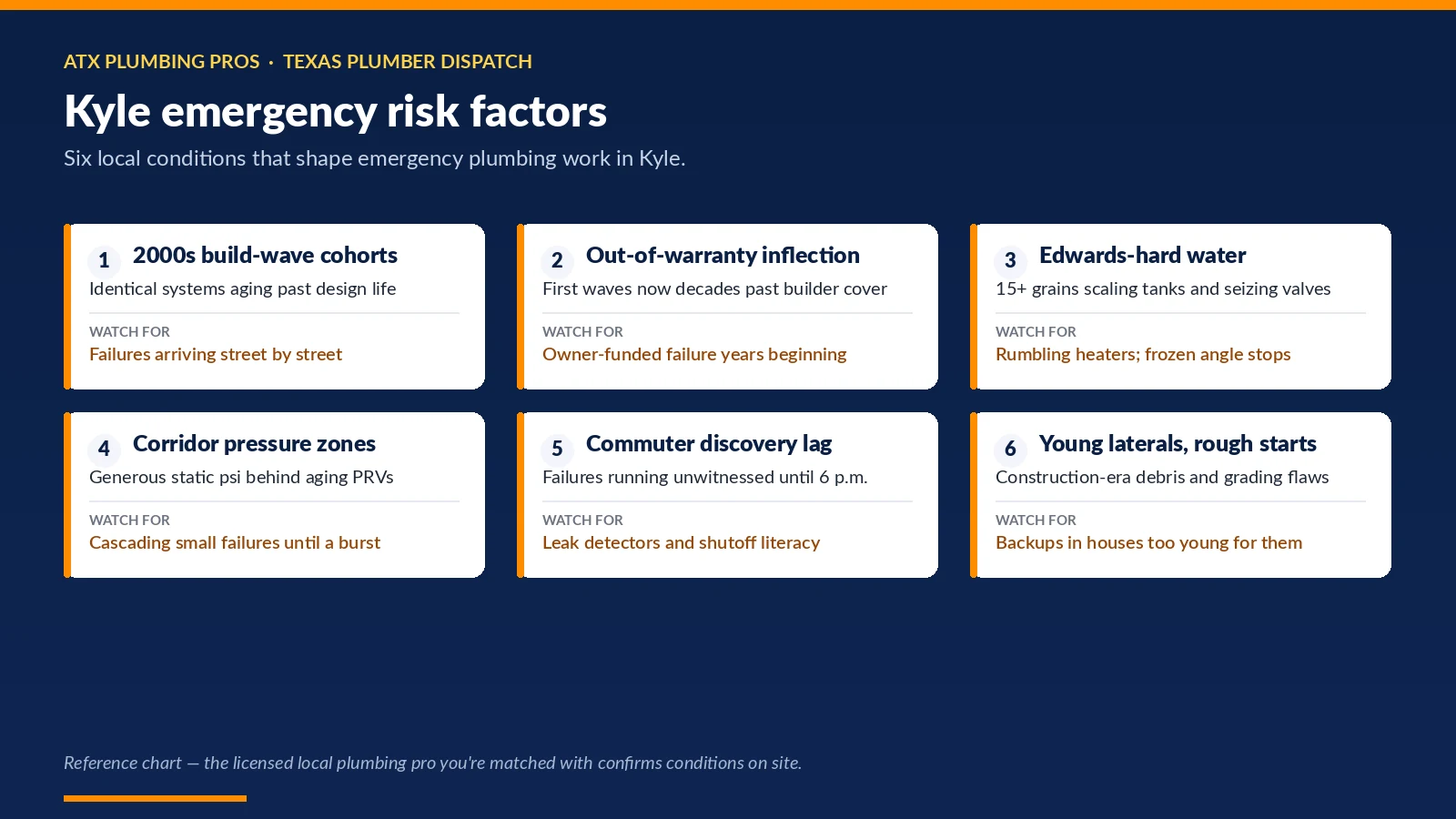
Kyle emergency risk factors, mapped
Six local conditions shape Kyle’s emergency-call pattern:
| Local factor | What it does to plumbing | What to watch for |
|---|---|---|
| 2000s build-wave cohorts | Identical systems aging past design life | Failures arriving street by street |
| Out-of-warranty inflection | First waves now decades past builder cover | Owner-funded failure years beginning |
| Edwards-hard water | 15+ grains scaling tanks and seizing valves | Rumbling heaters; frozen angle stops |
| Corridor pressure zones | Generous static psi behind aging PRVs | Cascading small failures until a burst |
| Commuter discovery lag | Failures running unwitnessed until 6 p.m. | Leak detectors and shutoff literacy |
| Young laterals, rough starts | Construction-era debris and grading flaws | Backups in houses too young for them |
Which Kyle areas does the dispatch line cover?
Independent licensed plumbers in the network take dispatch calls across Kyle, including:
Kyle emergency questions, answered straight
Where is the main shutoff in a Kyle subdivision house?
Almost always one of two places: inside the garage where the supply line enters through the front wall — frequently beside the water-softener loop — or at the curbside meter box, where the city stop closes with a meter key or wrench. Find both this weekend, confirm the garage valve actually turns (Kyle’s hard water seizes neglected valves), and show every adult in the house. It is the difference between a mop and a remediation crew.
My house is 18 years old and things keep failing. Coincidence?
Schedule, not coincidence. Your house’s heater, PRV and supply hoses were installed in one season with ten-to-fifteen-year design lives — at eighteen years you are living past the end of all three clocks at once, and so is your whole street. The efficient response is a proactive sweep: pressure gauged, heater assessed honestly, rubber hoses swapped for braided stainless, angle stops exercised. One planned Saturday beats three emergency nights.
Is our water actually hard enough to matter?
Yes — the corridor draws Edwards-influenced water in the 15-plus grain range, which is firmly ‘very hard.’ The emergency-relevant effects: scale beds killing water heaters years early, and shutoff valves seizing so they fail exactly when needed. The comfort effects you already know. A properly sized softener is the counterweight, and in Kyle it pays for itself in appliance lifespans; short of that, exercise your valves and service the heater annually.
The toilets are gurgling and the shower drain backed up. What now?
Stop using water entirely — every flush and shower cycle arrives at the blockage — and call for dispatch. Gurgling across multiple fixtures plus the lowest drain backing up means the main line, not a fixture clog. In Kyle’s younger stock, the camera often finds construction-era debris or a grading flaw rather than decades of buildup; that footage matters, because a lateral that was never right is a documentation-and-accountability conversation, not just a cleaning bill.
Can I actually get a plumber in Kyle at night, or will it be morning?
The line answers 24/7 and matches against real availability across the corridor — Kyle, Buda, San Marcos-adjacent coverage — with active-water emergencies triaged first. Describe what is failing, your subdivision and whether the water is off; stabilized situations may sensibly schedule for first thing, while genuine emergencies dispatch now. Either way the first-ten-minutes coaching — shutoff, pressure relief, documentation — starts on the call.
More Kyle plumbing searches
Start from the Kyle city guide for the full local picture, or jump straight to the search that matches your problem.
Heater let go in the garage, or a hose spraying since noon?
Shut the main, then tell the line your subdivision and build year — in cohort-built Kyle those two facts usually name the failure before the truck rolls. Independent TSBPE-licensed plumbers, matched 24/7.
Austin Plumbing Pros is a dispatch and referral service, not a licensed plumbing contractor. All work is performed by independent Texas-licensed (TSBPE) plumbers who hold their own license, insurance and bond. Availability varies by area and time of day.