Slab leak repair in Georgetown — a city split down the middle by geology, with twelve thousand Sun City slabs aging on one calendar.
Georgetown’s slab leaks obey two maps. The geological one splits the city at roughly I-35: west of it, homes sit on Edwards limestone bench — stable ground, but water hard enough to chew copper from the inside; east of it, Blackland clay swells and shrinks, working slabs and their embedded lines mechanically. The demographic map adds the second pattern: Sun City Texas — twelve-thousand-plus homes built in waves since the mid-1990s — is a masterclass in cohort plumbing, identical systems aging in lockstep, in households that travel for weeks at a stretch. Hard-water chemistry, moving clay and snowbird vacancy: Georgetown’s three slab-leak accelerants. The dispatch line matches Georgetown homeowners with independent licensed plumbers who work all three.
📞 Call (737) 283-6243 — 24/7 Dispatch
One call, no forms, no waiting on callbacks. Describe the problem, and the line matches you with an independent licensed plumber serving Georgetown — nights, weekends and holidays included. By calling, you consent to be connected with an independent licensed plumbing company serving your area.
Quick answer: Slab leak tells in Georgetown: a warm floor patch, a bill step on the city’s tiered rates, the meter’s low-flow dial moving with everything off, or water sounds in a quiet house — and in Sun City, a neighbor’s leak is a cohort warning. Call (737) 283-6243, 24/7. The line matches you with an independent TSBPE-licensed plumber who locates precisely and knows the west-side rock from the east-side clay.
How does Georgetown’s split geology produce two kinds of slab leak?
West of the interstate, the ground barely moves — and the water never stops working. Homes on the limestone bench enjoy unusually stable foundations, but Georgetown’s water runs among the hardest of any Texas city its size, drawn from limestone country and delivering 20-plus grains in stretches. Inside copper lines, that chemistry drives the hot-side erosion-corrosion cycle: mineral-laden water, heated and pushed through under-slab runs, thins pipe walls at every turn and contact point until a pinhole opens. West-side slab leaks are chemistry leaks — they cluster on hot lines, favor recirculating systems, and arrive without any foundation drama at all.
East of I-35, the classic Central Texas mechanism takes over: Blackland clay swelling with rain and shrinking through drought, flexing slabs season after season, wearing embedded copper at contact points and loading joints until August — slab-leak season across the clay belt — finds the year’s weakest spot. East-side leaks are mechanical leaks: they track the moisture cycle, they accompany foundation movement, and the foundation-watering culture that fights the shrink also complicates the diagnosis by keeping slab perimeters wet.
The two mechanisms want different long-term answers, which is why the address matters before the first quote. A west-side chemistry leak in a house with no softener argues for water treatment alongside the repair — fixing the pinhole without addressing 20-grain water schedules the next one. An east-side mechanical leak argues the McKinney logic: consistent foundation moisture, precision location, and reroute-versus-repair math driven by how many contact points share the failed line’s age. Same symptom, two cities’ worth of difference.
Why is Sun City its own slab-leak story?
Scale and synchrony. Sun City Texas is one of the largest active-adult communities in the state — twelve-thousand-plus homes built in successive waves from the mid-1990s onward, each wave plumbed identically in the same construction seasons. Those systems are now aging in lockstep: the earliest neighborhoods’ under-slab copper is deep into wear years, mid-2000s sections are entering them, and when one house on a street develops its first pinhole, every identical floor plan around it holds the same clock. Local plumbers track which phases are producing leaks the way actuaries track cohorts — because that is exactly what they are.
The vacancy factor raises the stakes uniquely here. Sun City households travel — snowbird months, long visits to grandchildren, RV seasons — and a slab leak that starts during week one of an eight-week absence runs silently the whole time: no warm floor noticed, no water sounds heard, just a returning homeowner meeting a four-figure utility bill, saturated flooring, or the mold line that weeks of moisture buys. The counter-moves are standard and underused: shutting the main at the street or house valve before travel (two minutes), smart leak detectors with automatic shutoff valves (increasingly common in the community), and a neighbor or service checking the meter’s low-flow dial weekly.
Post-tension construction runs through much of the community, bringing the familiar consequence: slab cutting is a specialist decision, and most Sun City slab leaks resolve by overhead reroute — abandoning the failed under-slab run and re-routing through the attic — often extended, on second leaks, into rerouting the whole hot side. In cohort housing, that math strengthens: the neighbor’s leak plus your own first leak is a trendline, and retiring the vulnerable runs on your schedule beats serial discoveries on the pipe’s.
From suspicion to fix — what does the Georgetown sequence look like?
Confirmation first, concrete last. The meter test opens: every fixture off, watch the low-flow indicator — movement confirms a leak somewhere past the meter. Hot-side isolation narrows it: close the water heater’s cold inlet; if the dial stops, the leak lives on the hot side (as most do). Then professional location — acoustic listening, thermal imaging across floors, pressure isolation by segment — puts the failure within inches before anyone opens anything. On Georgetown’s tiered water rates, this sequence has urgency: a running slab leak bills at the top tiers until it stops.
Repair paths follow the house. Conventional slabs take spot repairs cleanly when the line is otherwise sound: open at the located point or tunnel beneath, repair, document. Post-tension slabs — most of the city’s newer stock and much of Sun City — default to reroute, leaving the cabled slab sealed. Repeat leakers and cohort-age systems graduate to partial or full repipes, and west-siders get the treatment conversation in the same visit: a softener sized to Georgetown’s actual hardness removes the chemistry that drilled the pinhole, and pairing treatment with repair is the difference between fixing a leak and ending a series.
Close with paper and prevention, Georgetown edition: written location and repair documentation (the city’s resale market moves fast, and Sun City buyers’ inspectors ask), pressure gauged annually (regulators here protect against limestone-country zone pressures and age like all regulators), water treatment where the west-side chemistry warrants, consistent foundation watering on the east-side clay — and for every traveling household, the two-minute habit of shutting the main before the suitcase closes. In a city split by geology and synchronized by cohorts, prevention is unusually predictable — which makes it unusually worth doing.
What else does the line cover for Georgetown homes?
Every card below links to a detailed service guide — what the work involves, what drives the effort, and what to check before anyone arrives. The dispatch line covers all of it for Georgetown.
24/7 Emergency Plumbing
Burst pipes, active leaks, sewage backups — the line answers around the clock and routes you to a licensed plumber on call.
Water Heater Repair
Tank and tankless diagnosis — no hot water, pilot failures, sediment noise, leaking T&P valves.
Drain Cleaning
Snaking, hydro-jetting and camera scoping for kitchen, shower and mainline clogs.
Leak Detection
Acoustic and thermal location of hidden leaks before they become demolition projects.
Slab Leak Detection
Under-slab pinpointing so the plumber opens one spot in the foundation, not five.
Sewer Line Repair
Camera-verified diagnosis, trenchless lining and pipe bursting where the ground allows.
Tankless Water Heaters
Sizing, gas-line checks and descaling schedules matched to local water hardness.
Water Softener Installation
Grain-capacity sizing based on the hardness that actually comes out of local taps.
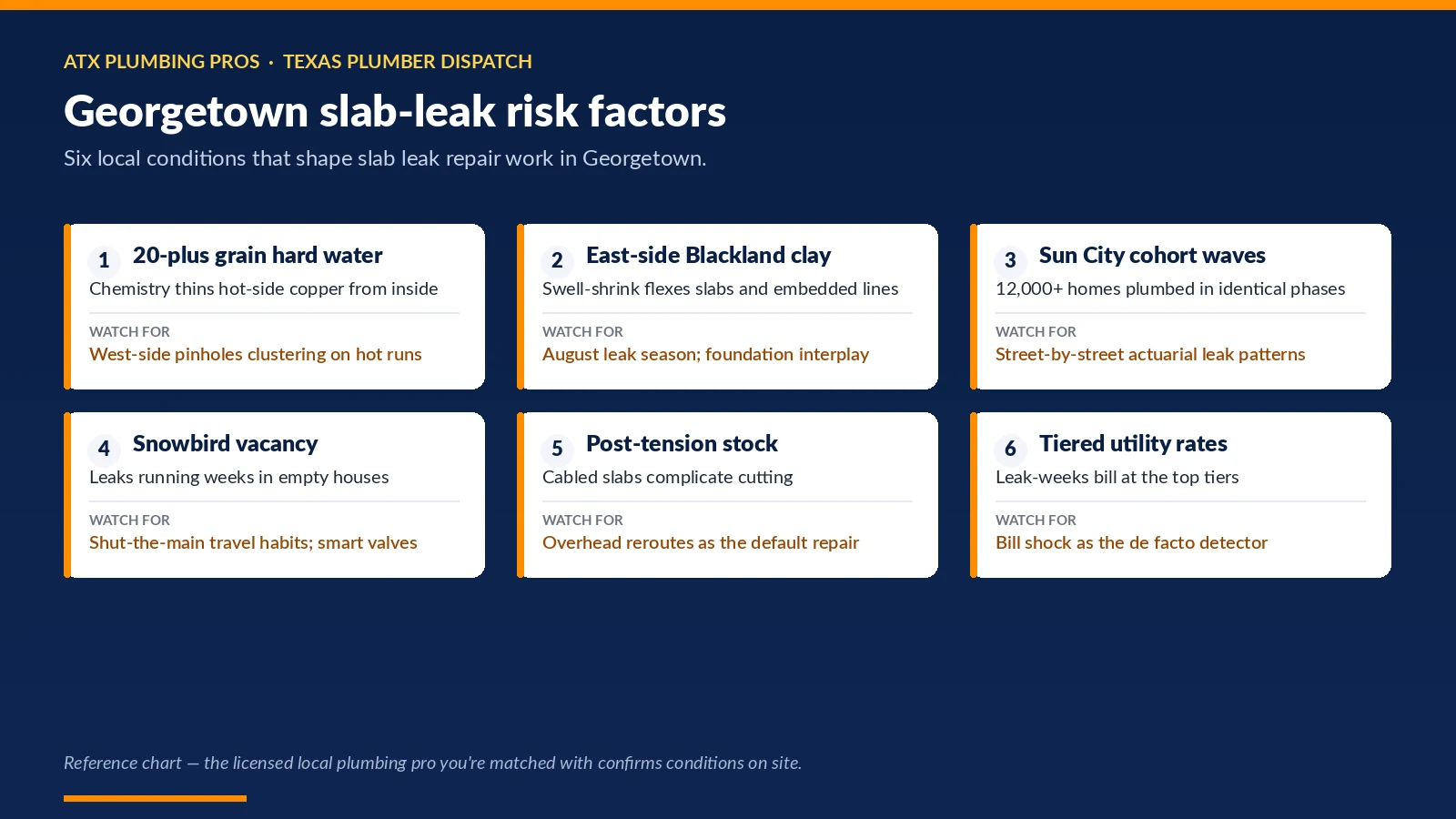
Georgetown slab-leak risk factors, mapped
Six local conditions drive Georgetown’s slab-leak pattern:
| Local factor | What it does to plumbing | What to watch for |
|---|---|---|
| 20-plus grain hard water | Chemistry thins hot-side copper from inside | West-side pinholes clustering on hot runs |
| East-side Blackland clay | Swell-shrink flexes slabs and embedded lines | August leak season; foundation interplay |
| Sun City cohort waves | 12,000+ homes plumbed in identical phases | Street-by-street actuarial leak patterns |
| Snowbird vacancy | Leaks running weeks in empty houses | Shut-the-main travel habits; smart valves |
| Post-tension stock | Cabled slabs complicate cutting | Overhead reroutes as the default repair |
| Tiered utility rates | Leak-weeks bill at the top tiers | Bill shock as the de facto detector |
Which Georgetown areas does the dispatch line cover?
Independent licensed plumbers in the network take dispatch calls across Georgetown, including:
Georgetown slab-leak questions, answered straight
We are leaving for two months. How do we make sure a slab leak cannot ruin the trip?
Shut the main — at the house valve or the meter — before you go; a system holding no pressure cannot flood anything. If the house needs water on (irrigation controllers, softener regeneration), the next tier is a smart leak-detection valve that watches flow patterns and closes automatically, plus a neighbor glancing at the meter’s low-flow dial weekly. Sun City’s worst leak stories are all vacancy stories; two minutes at the valve rewrites them.
Why does my neighborhood seem to be getting leak after leak?
Because it was plumbed in one season. Sun City phases and Georgetown’s subdivision waves installed identical under-slab systems street by street, and identical systems reach wear age together — the first leak on a street is the cohort announcing itself, not bad luck. Treat it as intelligence: a precision pressure test and location survey on your own system, or a proactive reroute of the hot side, costs a fraction of the discovery version.
Does hard water really cause slab leaks, or is that a softener sales pitch?
The mechanism is real and the west side of Georgetown demonstrates it: mineral-heavy water moving hot through copper drives erosion-corrosion, thinning walls at turns and contact points until pinholes open — no soil movement required. A softener does not repair existing thinning, but it removes the accelerant for every year after installation. On a west-side house with its first hot-side pinhole, treatment-plus-repair is the honest prescription; repair alone schedules a sequel.
Can you cut into a Sun City post-tension slab to fix the leak?
Cables can be located and safe openings made, but on post-tension homes the industry default is better: reroute overhead, abandoning the failed run and leaving the slab sealed. It avoids the cable risk entirely, usually finishes faster, and permanently retires the leaking segment — which matters in cohort housing where that segment’s twins are aging identically. Most Sun City leaks resolve this way, and second leaks usually extend the logic to the whole hot side.
How do I know the wet floor is a slab leak and not something else?
Run the eliminations: the meter test (all water off — a moving low-flow dial means the plumbing is losing water), then hot-side isolation at the water heater, then a look at the innocent suspects — shower pans, toilet seals, HVAC condensate lines and, on the east side, foundation watering wicking under flooring. A true slab leak usually pairs the meter evidence with warmth underfoot or a hot-water-heater that cycles constantly. The isolation sequence sorts it in under an hour.
More Georgetown plumbing searches
Start from the Georgetown city guide for the full local picture, or jump straight to the search that matches your problem.
Bill jumped two tiers, or a warm patch where the dog now sleeps?
Run the meter test, then tell the line which side of I-35 and the house’s vintage — in Georgetown those two facts usually name the mechanism. Independent TSBPE-licensed plumbers matched 24/7, Sun City cohort patterns known.
Austin Plumbing Pros is a dispatch and referral service, not a licensed plumbing contractor. All work is performed by independent Texas-licensed (TSBPE) plumbers who hold their own license, insurance and bond. Availability varies by area and time of day.