Plumber in Mueller, Austin — a new-urbanist district built on an old airport, where the plumbing is young, dense and standing on engineered fill.
Mueller is Austin’s newest old neighborhood — 700 acres of former municipal airport rebuilt since 2007 into row homes, yard houses, condos and shops on a compact alley-loaded grid. Its plumbing is unlike anywhere else in the city: nearly everything is PEX and PVC young enough to be healthy, tankless water heaters are closer to the rule than the exception, green-building standards shaped every install, and the first big build phases are now crossing the fifteen-year line where first-generation equipment starts asking questions. Underneath it all sits the district’s defining variable: engineered fill over reworked airport ground, where laterals and yard lines live or die by how well their trench compaction has held. The dispatch line matches Mueller homes with independent licensed plumbers fluent in new-urbanist stock, 24/7.
📞 Call (737) 283-6243 — 24/7 Dispatch
One call, no forms, no waiting on callbacks. Describe the problem, and the line matches you with an independent licensed plumber serving Austin — nights, weekends and holidays included. By calling, you consent to be connected with an independent licensed plumbing company serving your area.
Quick answer: Tankless error codes, alley-side sewer questions, condo or row-home plumbing issues, or a first-generation system aging out in Mueller: call (737) 283-6243. The line answers 24/7 and matches you with an independent TSBPE-licensed plumber who works the district — yard homes, row houses, Mueller’s condo buildings and the surrounding Windsor Park and Cherrywood edges.
What does fifteen years mean for Mueller’s first phases?
The 2007–2012 sections — the district’s pioneers — are crossing the age where original equipment meets its first real decisions. Tankless units from the early phases are at or past the point where heat exchangers, flow sensors and igniters begin needing attention, and where any skipped descaling years on Austin’s moderately hard water come due as error codes and fading output. The good news: tankless units are rebuildable in ways tanks never were — descale, sensor and valve service genuinely restores them — so year-fifteen rarely means replacement if maintenance starts now.
The tank-equipped minority runs the standard 10–12 year clock, many units in interior closets whose pans drain to daylight through routing worth verifying before it is needed. Recirculation pumps — common in Mueller’s efficiency-minded builds — are quiet consumables: when hot water suddenly takes minutes to arrive at the far bathroom, the pump, its check valve or its timer is usually the story.
And the era’s green-building specifics matter at service time: low-flow fixtures that dislike debris from a dying heater, manifold PEX systems whose home-run layouts confuse crews unfamiliar with them (but make isolation and repair dramatically cleaner for those who know them), and solar pre-heat or heat-pump water heaters on some homes that need technicians who have actually met one. Mueller’s stock rewards plumbers who work it regularly — which is precisely the matching problem the dispatch line solves.
What does building on an old airport actually change underground?
Mueller’s ground is engineered: runways and aprons were demolished, crushed and reworked, and the district was regraded with fill placed to specification. Done well — and Mueller’s was a professionally engineered redevelopment — that produces stable building pads. But buried utilities live in trenches, and trench backfill is only as good as its compaction: fifteen-plus years of settlement finds the spots where compaction varied, and a lateral crossing differentially settled fill can develop the low spots and joint stresses that show up as recurring slow drains years before they show up as failures.
The diagnostic implication is camera-forward: any Mueller drain that misbehaves twice deserves a recorded scope with a footage counter, because the question is geometric — has this young pipe developed a settlement dip? — and geometry only shows on screen. Caught early, a modest belly in PVC is a monitored condition or a targeted re-bed; ignored, it graduates into the clog-factory pattern.
Alley-loading adds the district’s access wrinkle: many services, cleanouts and meters live on the alley side, shared infrastructure runs tight corridors, and condo and mixed-use buildings layer HOA and party-wall questions onto simple-sounding repairs — whose line is it, where does the association’s responsibility end, which cleanout serves which unit. Crews who work Mueller keep those maps in their heads; crews who do not spend the first hour finding the cleanout.
How should Mueller owners run their young-stock playbook?
Start the tankless flush habit now if it never started: annual descaling through isolation valves on Austin water, semiannual for hard-running households — it is the single highest-leverage maintenance in the district, and it converts year-fifteen from replacement talk into routine service. Verify isolation valves exist (early installs sometimes skipped them; adding them is a one-time fix), and keep the unit’s condensate line clear — high-efficiency condensing units produce acidic condensate that must drain properly.
Learn your systems’ specifics while nothing is wrong: where the manifold is and which home-run serves which fixture (label it — ten minutes with a helper running taps), where the alley-side cleanout and meter sit, what the recirculation pump’s schedule is, and — in condos and row homes — what the association documents actually say about plumbing responsibility boundaries. Emergencies in dense product types are boundary problems as much as pipe problems; the owners who know their boundaries mitigate faster.
And treat the district’s youth as an asset with a maintenance contract: Mueller’s plumbing does not need the archaeology that Hyde Park demands or the cohort triage of a ’90s suburb — it needs disciplined care of good modern systems, camera checks when drains repeat, and technicians matched to its particular technology mix. That is the whole playbook, and run on schedule it keeps this district’s plumbing as new-feeling as its parks.
What Austin services does the line cover from Mueller?
Every card below links to a detailed service guide — what the work involves, what drives the effort, and what to check before anyone arrives. The dispatch line covers all of it for Austin.
24/7 Emergency Plumbing
Burst pipes, active leaks, sewage backups — the line answers around the clock and routes you to a licensed plumber on call.
Water Heater Repair
Tank and tankless diagnosis — no hot water, pilot failures, sediment noise, leaking T&P valves.
Drain Cleaning
Snaking, hydro-jetting and camera scoping for kitchen, shower and mainline clogs.
Leak Detection
Acoustic and thermal location of hidden leaks before they become demolition projects.
Slab Leak Detection
Under-slab pinpointing so the plumber opens one spot in the foundation, not five.
Sewer Line Repair
Camera-verified diagnosis, trenchless lining and pipe bursting where the ground allows.
Tankless Water Heaters
Sizing, gas-line checks and descaling schedules matched to local water hardness.
Water Softener Installation
Grain-capacity sizing based on the hardness that actually comes out of local taps.
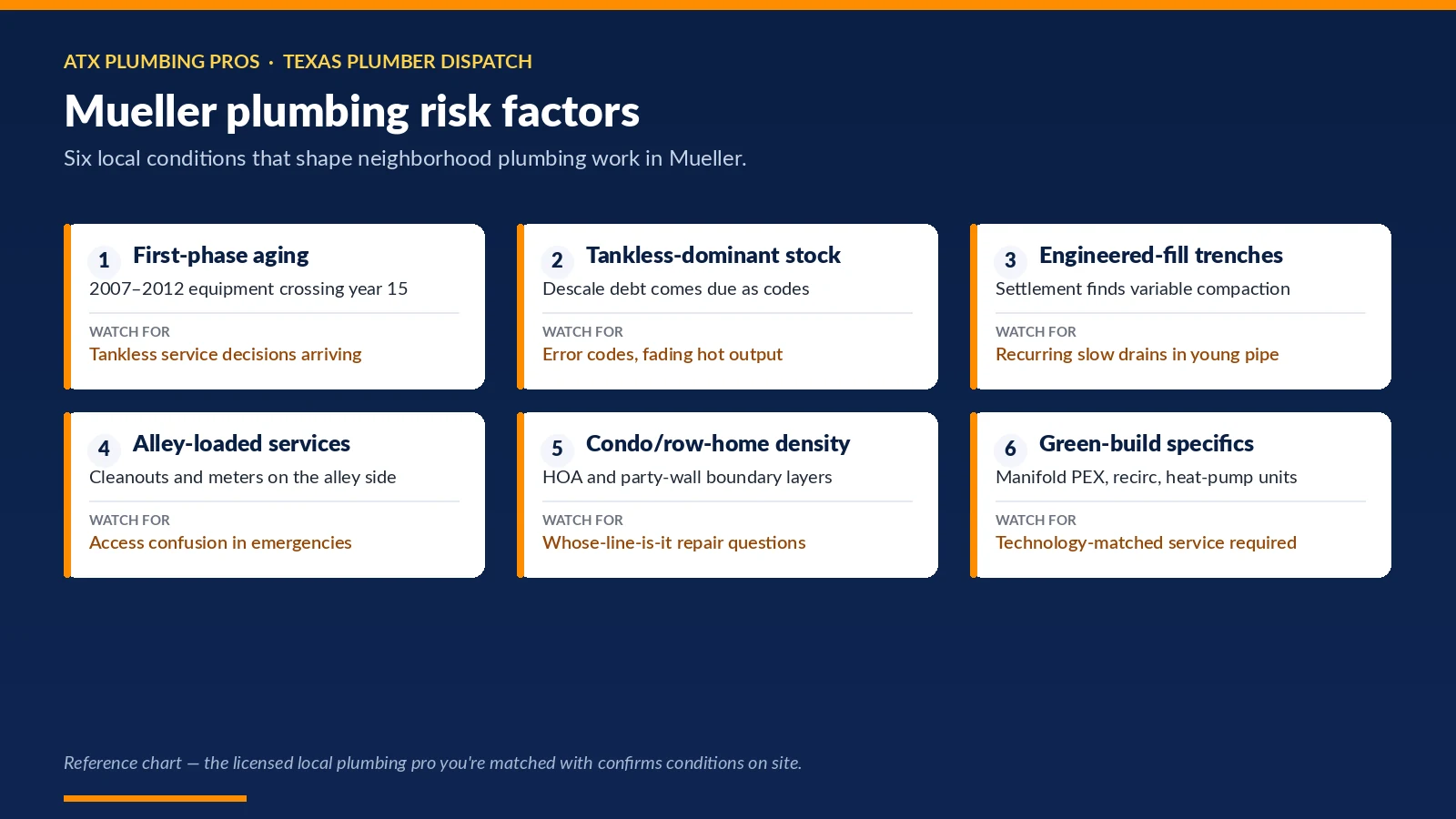
Mueller plumbing risk factors, mapped
Six local conditions produce most of Mueller’s plumbing calls:
| Local factor | What it does to plumbing | What to watch for |
|---|---|---|
| First-phase aging | 2007–2012 equipment crossing year 15 | Tankless service decisions arriving |
| Tankless-dominant stock | Descale debt comes due as codes | Error codes, fading hot output |
| Engineered-fill trenches | Settlement finds variable compaction | Recurring slow drains in young pipe |
| Alley-loaded services | Cleanouts and meters on the alley side | Access confusion in emergencies |
| Condo/row-home density | HOA and party-wall boundary layers | Whose-line-is-it repair questions |
| Green-build specifics | Manifold PEX, recirc, heat-pump units | Technology-matched service required |
Which Austin areas does the dispatch line cover?
Independent licensed plumbers in the network take dispatch calls across Austin, including:
Mueller plumbing questions, answered straight
My tankless unit was installed in 2009 and has never been flushed. Is it too late?
Usually not — but go professional rather than DIY for the first one. A unit with fifteen years of scale needs a long, sometimes staged descaling, a check of the inlet screen, flow sensor and heat exchanger condition, and isolation valves added if the original install skipped them. Most units come back impressively; occasionally the assessment honestly concludes the exchanger is too far gone, and you decide with facts. Either way, the annual habit starts now.
Why do my drains run slow every few months when the plumbing is so new?
Young pipe with a geometry question: on engineered fill, trench settlement can dip a lateral enough to slow solids without blocking flow — the recurring-slowdown signature. A recorded camera scope answers it definitively: standing water at a fixed footage marker means a settlement low spot; clear geometry means the cause is habits or a fixture-side issue. In PVC this young, a caught-early dip is a targeted fix, not a replacement.
In my row home, which plumbing is mine and which is the HOA’s?
Your association documents draw the line — commonly, everything serving only your unit is yours, shared laterals and stacks are the association’s, and the boundary sits at the branch connection. Mueller’s associations vary, so read yours before the emergency and save the plat showing your cleanout. When a shared-line backup happens, document which units are affected — multi-unit symptoms are the evidence that moves a repair to the association’s side of the ledger.
Where is my water shutoff in an alley-loaded Mueller home?
Usually two answers: a house-side valve — often in the garage, a utility closet, or near the manifold — and the meter with its curb stop on the alley or street side depending on your block’s layout. Find both on a calm day; alley-side meters can hide behind bins and landscaping exactly when seconds matter. Manifold-equipped homes have a bonus: individual home-run valves that can isolate one fixture without dropping the house.
Do heat-pump water heaters and solar pre-heat systems need special service?
They need familiar-with-it service: heat-pump units want condensate management, filter cleaning and refrigerant-side literacy; solar pre-heat adds collector loops, controllers and mixing valves upstream of a conventional unit. Both reward technicians who work them regularly — misdiagnosis by an unfamiliar crew is the common failure mode. Mention your equipment type when you call and the line matches accordingly; Mueller has enough of both that the specialists exist.
More Austin plumbing searches
Start from the Austin city guide for the full local picture, or jump straight to the search that matches your problem.
Young house, first real plumbing question?
Describe the equipment — tankless age, drain pattern, boundary puzzle — and the line matches you with an independent TSBPE-licensed plumber who works Mueller’s stock and its technology mix every week. 24/7.
Austin Plumbing Pros is a dispatch and referral service, not a licensed plumbing contractor. All work is performed by independent Texas-licensed (TSBPE) plumbers who hold their own license, insurance and bond. Availability varies by area and time of day.