Water heater repair in Frisco — where a whole city’s tanks were installed in fifteen years and are now aging out in the same fifteen.
Frisco built faster than almost any city in America — from prairie to a couple hundred thousand people largely between 1998 and 2015 — and its water heaters carry that birth certificate. Builder-grade 40- and 50-gallon tanks went into attics and upstairs closets by the subdivision-load, engineered for a 10–12 year life, which means the 2004 streets aged out together, the 2008 streets are aging out now, and the 2012–15 belt is next on the conveyor. Add NTMWD’s moderately hard water quietly stacking sediment on every tank floor, attic installs where a failure’s first symptom is a ceiling stain, and a fast-growing tankless cohort with its own maintenance leash, and Frisco’s water-heater story is really a cohort-management story. The dispatch line answers it 24/7.
📞 Call (737) 283-6243 — 24/7 Dispatch
One call, no forms, no waiting on callbacks. Describe the problem, and the line matches you with an independent licensed plumber serving Frisco — nights, weekends and holidays included. By calling, you consent to be connected with an independent licensed plumbing company serving your area.
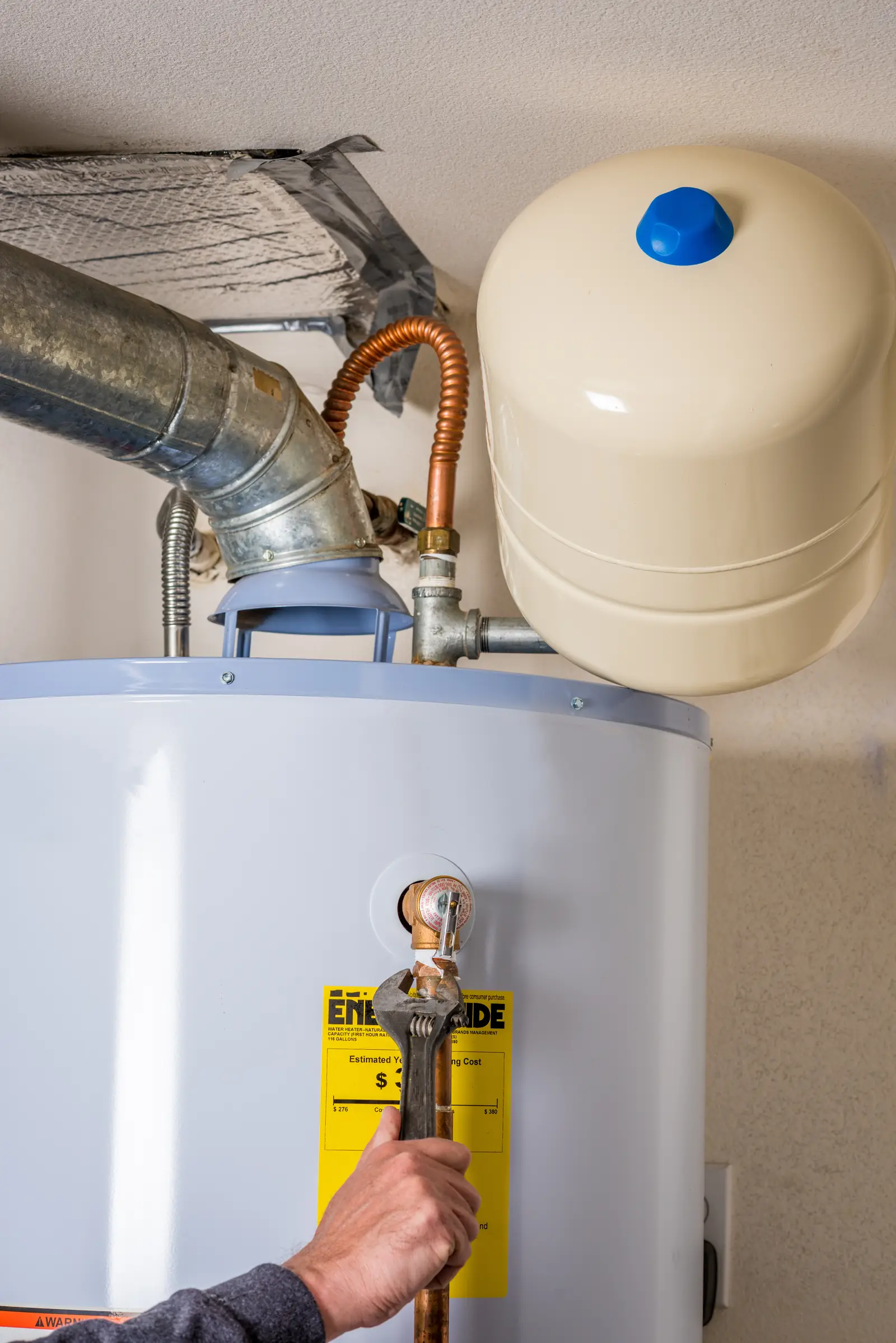
Quick answer: No hot water, a leaking tank, rumbling sounds, or a ceiling stain under an attic unit in Frisco: call (737) 283-6243. If the tank is actively leaking, close the cold-inlet valve on top of the heater first and kill power or gas. The line answers 24/7 and matches you with an independent TSBPE-licensed plumber who repairs and replaces tank and tankless units across Frisco.
Why do Frisco water heaters fail on such a predictable schedule?
Because they were installed on one. Tract builders plumbing four hundred homes in a season bought the same tank in bulk, and every one of those units shares a design life of roughly 10–12 years. Streets built in 2006 hit the failure window together around 2016–18; the enormous 2010–15 cohort is entering it now. When two houses on your street replace tanks in the same quarter, that is not coincidence — it is your serial plate telling you to check your own installation date.
NTMWD water does the aging. North Texas Municipal Water District supplies come in moderately hard — enough that dissolved minerals drop out of solution every time the burner fires, settling as sediment on the tank floor. The sediment layer insulates water from flame, so the burner runs longer for the same shower, overheating the steel beneath and popping and rumbling as steam pockets escape the layer. That rumble is the tank narrating its own decline.
The anode rod is the neglected variable. Every glass-lined tank carries a sacrificial rod that corrodes so the tank wall does not; in Frisco’s water it is typically consumed in 4–6 years, after which corrosion starts on the tank itself. Builder-grade units almost never get an anode check — homeowners who replace the rod at year five routinely get several extra years; the ones who never look get the cohort average.
What makes attic installs the Frisco-specific risk?
Most of Frisco’s two-story stock puts the water heater in the attic — space-efficient at build time, consequential at failure time. A 50-gallon tank that lets go two floors up sends water through insulation, ceiling drywall, and whatever rooms sit below, and the damage clock runs at gravity speed. The design defense is the drain pan under the unit and its dedicated drain line to a soffit or exterior wall — but pans crack, lines clog with insulation debris, and a pan whose drain does not actually daylight is decoration.
The five-minute annual check every Frisco attic-tank owner should run: confirm the pan is intact and dry, pour a cup of water into it and verify it appears at the outside termination, look at the flex connectors for corrosion bloom, and read the age off the serial plate. Corroded braided connectors fail more often than tanks themselves, and they fail at full line pressure.
The freeze factor is real up here too. Attic units sit above the insulation blanket in Frisco’s coldest micro-zone; February 2021 killed heaters outright and split their connectors across the city. TPR discharge lines and connectors in attics should be insulated, and any tankless unit mounted on an exterior wall or in an unconditioned garage needs its freeze-protection power maintained — the units protect themselves electrically, which is no help during an outage.
Repair, replace, or go tankless — how does the math run here?
Age decides most of it. Under eight years, most failures — thermocouples, gas valves, heating elements, thermostats — are worth repairing; the tank has life left. Past ten, spending on a control repair buys months on a vessel whose floor is sediment-loaded and whose anode is long gone; the honest conversation compares that repair against replacement, and any leak from the tank body itself ends the conversation — tanks do not heal.
Replacement in Frisco has a code wrinkle worth knowing: attic installations must meet current requirements — pan, drain, combustion air, seismic-adjacent strapping is not required here but expansion tanks are where the meter side creates a closed system, and permits are enforced. A like-for-like swap quote that skips the permit is skipping the inspection that protects your ceiling.
Tankless adoption in Frisco is among the strongest in Texas — new builds increasingly ship with wall units — and the technology fits the housing stock: endless hot water for four-bath homes, no 50-gallon bomb in the attic. The leash is maintenance: NTMWD hardness scales heat exchangers, and an annual vinegar flush through isolation valves is what keeps the efficiency and the warranty. A tankless quote without isolation valves is a unit nobody plans to maintain.
What other Frisco plumbing does the line cover?
Every card below links to a detailed service guide — what the work involves, what drives the effort, and what to check before anyone arrives. The dispatch line covers all of it for Frisco.
24/7 Emergency Plumbing
Burst pipes, active leaks, sewage backups — the line answers around the clock and routes you to a licensed plumber on call.
Water Heater Repair
Tank and tankless diagnosis — no hot water, pilot failures, sediment noise, leaking T&P valves.
Drain Cleaning
Snaking, hydro-jetting and camera scoping for kitchen, shower and mainline clogs.
Leak Detection
Acoustic and thermal location of hidden leaks before they become demolition projects.
Slab Leak Detection
Under-slab pinpointing so the plumber opens one spot in the foundation, not five.
Sewer Line Repair
Camera-verified diagnosis, trenchless lining and pipe bursting where the ground allows.
Tankless Water Heaters
Sizing, gas-line checks and descaling schedules matched to local water hardness.
Water Softener Installation
Grain-capacity sizing based on the hardness that actually comes out of local taps.
Frisco water-heater risk factors, mapped
Six local conditions produce most of Frisco’s water-heater calls:
| Local factor | What it does to plumbing | What to watch for |
|---|---|---|
| Cohort installation waves | Whole subdivisions’ tanks share birthdays | Street-wide failure seasons |
| Attic installations | Failures start two floors above the flooring | Ceiling stains as first symptom |
| NTMWD hardness | Sediment blankets tank floors | Rumbling, popping, slow recovery |
| Consumed anode rods | Sacrificial protection gone by year 5–6 | Tank-wall corrosion begins unseen |
| Builder-grade connectors | Braided flex lines corrode at full pressure | Drips and blooms at the fittings |
| Tankless scale leash | Hard water coats heat exchangers | Error codes, fading output without flushes |
Which Frisco areas does the dispatch line cover?
Independent licensed plumbers in the network take dispatch calls across Frisco, including:
Frisco water-heater questions, answered straight
How do I find out how old my water heater actually is?
Read the serial number plate on the tank — manufacturers encode the build date in the first characters (the format varies by brand; the installer sticker often states it plainly too). Frisco’s stock skews young but not young enough: a 2010 house is carrying a fifteen-year-old original. Past ten years, start planning the replacement on your schedule; past twelve, every additional winter is borrowed.
My attic heater is fine but the pan has water in it. Emergency?
Treat it as one in slow motion. Pan water means something is discharging — a weeping TPR valve, a sweating connector, or the tank’s first leak — and the pan is your last line of defense. Close the cold-inlet valve if the level is rising, and get it diagnosed promptly. Also confirm the pan drain line actually flows to daylight; a full pan with a clogged drain is a ceiling stain on a timer.
Is the rumbling sound from my water heater dangerous?
The rumble is steam escaping under the sediment blanket on the tank floor — not an explosion risk by itself (the TPR valve guards that), but a clear sign the tank is running inefficient and hot. Under eight years old, a flush can quiet it and extend life. Past ten with heavy rumble, flushing sometimes opens pinholes the sediment was sealing — which is why older tanks get the replacement conversation instead of an aggressive flush.
Do I need a permit to replace a water heater in Frisco?
Yes — Frisco requires a plumbing permit for water-heater replacement, and the inspection checks the things that protect the house: pan and drain in attic installs, TPR discharge routing, gas connections and combustion air, and the expansion tank where the system is closed. Licensed plumbers handle the permit as part of the job. A quote that skips it is waiving the one independent check on work above your ceiling.
Should my next unit be tankless?
In Frisco’s housing the case is genuinely strong: multi-bath demand, gas already run, attic tanks worth evicting. The honest caveats: upfront cost is higher, hard water demands an annual descaling flush (insist on isolation valves at install), winter inlet temperatures cut peak flow so sizing matters, and freeze protection depends on house power. Homes that accept the annual flush get decades; homes that will not maintain a unit are better served by a quality tank in a pan that drains.
More Frisco plumbing searches
Start from the Frisco city guide for the full local picture, or jump straight to the search that matches your problem. The full service directory covers every guide on the site.
Cold shower, or a pan filling two floors up?
Close the cold inlet, kill the power or gas, and describe the unit and your neighborhood. The line answers 24/7 and matches you with an independent TSBPE-licensed plumber who works Frisco’s tank and tankless cohorts every week.
Austin Plumbing Pros is a dispatch and referral service, not a licensed plumbing contractor. All work is performed by independent Texas-licensed (TSBPE) plumbers who hold their own license, insurance and bond. Availability varies by area and time of day.