Burst pipe repair in El Paso — a city built for heat, ambushed by cold, with its most vulnerable plumbing up on the roof.
El Paso’s burst-pipe story is unlike any other Texas city’s, and February 2011 wrote it in the record: a multi-day arctic siege that froze pipes across a city engineered entirely for sun, broke water infrastructure at scale, and left whole districts hauling water. The vulnerabilities it exposed are structural. Swamp-cooler supply lines run across rooftops — quarter-inch copper in the open wind. Water heaters and their piping sit in exterior closets and carports. Insulation assumes cold is someone else’s problem. Add foothill pressure zones running high off the mountain and 3,700-foot solar swings that freeze nights even in mild winters, and a hard snap here bursts pipes in places plumbers elsewhere never think to look. The dispatch line matches El Paso homeowners with independent licensed plumbers who know exactly where to look.
📞 Call (737) 283-6243 — 24/7 Dispatch
One call, no forms, no waiting on callbacks. Describe the problem, and the line matches you with an independent licensed plumber serving El Paso — nights, weekends and holidays included. By calling, you consent to be connected with an independent licensed plumbing company serving your area.
Quick answer: Burst pipe in El Paso: shut the water at the house valve or curb stop first — every minute at city pressure is gallons into the structure — then call (737) 283-6243, 24/7. The line matches you with an independent TSBPE-licensed plumber who handles El Paso’s signature bursts: rooftop swamp-cooler lines, exterior-closet heater piping, and freeze splits that reveal themselves at thaw.
Why does a city this warm burst so many pipes?
Because nothing here was built for the exception. El Paso averages three hundred days of sun, and its housing reflects that honestly: water heaters in exterior closets and carports, supply piping through uninsulated exterior walls and attics that were designed as heat shields rather than cold barriers, hose bibs and irrigation manifolds standing exposed — and, uniquely, thousands of evaporative-cooler supply lines crossing open rooftops, because for eight months a year the swamp cooler is the most important appliance in the house. All of it is rational desert construction. All of it is also a freeze-casualty list.
The physics needs less time than people assume. A quarter-inch copper cooler line on a rooftop in a 20°F night with wind loses heat almost instantly; it has no thermal mass, no insulation and no shelter. Exterior-wall runs and carport heater connections follow. And El Paso’s altitude adds a subtlety: at 3,700 feet with dry air, radiative cooling is fierce — clear-sky nights drop below freezing here through much of winter even when afternoons hit 65°F, so the freeze-thaw cycle runs dozens of times a season on any line left exposed. Most cycles the ice plug melts harmlessly. The one that split the pipe announces itself when it thaws.
2011 remains the reference event because it stacked every failure at once: five consecutive hard-freeze days, rolling outages that killed heat, bursts across tens of thousands of homes, and pressure loss across the utility itself. Its legacy is double-edged — a large cohort of homes carries 2011-era emergency splices of uneven quality that are now aging repairs in their own right, and a citywide institutional memory that takes forecast freezes seriously. The homes that flooded twice learned; the pipes that were patched in a hurry are still out there.
What should happen in the first ten minutes of a burst?
Water off — and in El Paso, knowing where and how matters more than usual. The house shutoff may be at an exterior wall, in a below-grade box at the property line, or effectively absent on older stock; and in the city’s hard, mineral-heavy water, valves that have not turned in a decade are often scale-seized exactly when needed. Finding the valve on a calm afternoon and exercising it twice a year is the highest-return fifteen minutes in this guide. If the house valve fails, the curb stop at the meter is the fallback — a wrench-operated utility valve that stops everything.
For the rooftop burst — the El Paso special — there is a shortcut worth knowing: the swamp-cooler line usually tees off the house supply with its own small saddle or ball valve. If water is sheeting off the roof or staining a ceiling below the cooler, closing that one valve isolates the casualty while the rest of the house keeps running water. Then relieve the system: open a low faucet, and in freeze events open the affected line’s taps so the remaining ice can push meltwater somewhere harmless.
Then triage what the water touched. Desert construction hides water damage well — flat and low-slope roofs pond and telegraph leaks far from the split, adobe and plaster wick moisture invisibly, and the dry climate evaporates surface evidence while saturation continues inside assemblies. Photograph everything for insurance before cleanup, get air moving across wet materials, and let the arriving plumber pressure-test the whole affected circuit rather than just the visible failure — freeze events rarely split only one spot, and the second, silent casualty is the one that grows mold behind a closet.
How do repairs and prevention differ in El Paso’s housing stock?
Repair triage follows the material and the mission. Rooftop cooler lines are the quick win — small-bore copper or poly replaced in an afternoon, ideally re-routed or insulated on the way back, with the seasonal drain-and-refill habit (drain the cooler line every fall, recharge at first heat) built into the household calendar thereafter. Exterior-closet water heater piping gets repaired with freeze sleeves and heat tape added, because the closet is not moving. Interior wall splits in slab homes are the heavier lift — access, repair, and a conversation about whether that exterior-wall run should be rerouted through conditioned space while the wall is open.
The 2011-splice cohort deserves its own paragraph: emergency repairs made under duress — compression couplings on frozen lines, mixed materials, uninsulated redo runs — are now fifteen-year-old patches, and they fail under exactly the conditions that created them. When a plumber opens a wall and finds one, the professional move is upgrading the whole visible run, not splicing the splice. Foothill homes add the pressure variable: Franklin Mountains elevation zones run high static pressure at the low ends, and a failing regulator turns any weakened joint into a scheduled burst. A gauge on a hose bib reads the risk in five minutes.
Prevention, El Paso edition, is a short list with outsized returns: drain the swamp-cooler line before the first hard freeze and insulate what remains exposed; sleeve and heat-tape exterior-closet heater piping; know and exercise the main shutoff; gauge the pressure yearly in foothill zones; and on forecast hard freezes, run the standard drip-and-open-cabinets drill on any plumbing touching an exterior wall. It is a desert city’s version of winterization — small, specific and aimed exactly where this city actually splits.
What else does the line cover in El Paso?
Every card below links to a detailed service guide — what the work involves, what drives the effort, and what to check before anyone arrives. The dispatch line covers all of it for El Paso.
24/7 Emergency Plumbing
Burst pipes, active leaks, sewage backups — the line answers around the clock and routes you to a licensed plumber on call.
Water Heater Repair
Tank and tankless diagnosis — no hot water, pilot failures, sediment noise, leaking T&P valves.
Drain Cleaning
Snaking, hydro-jetting and camera scoping for kitchen, shower and mainline clogs.
Leak Detection
Acoustic and thermal location of hidden leaks before they become demolition projects.
Slab Leak Detection
Under-slab pinpointing so the plumber opens one spot in the foundation, not five.
Sewer Line Repair
Camera-verified diagnosis, trenchless lining and pipe bursting where the ground allows.
Tankless Water Heaters
Sizing, gas-line checks and descaling schedules matched to local water hardness.
Water Softener Installation
Grain-capacity sizing based on the hardness that actually comes out of local taps.
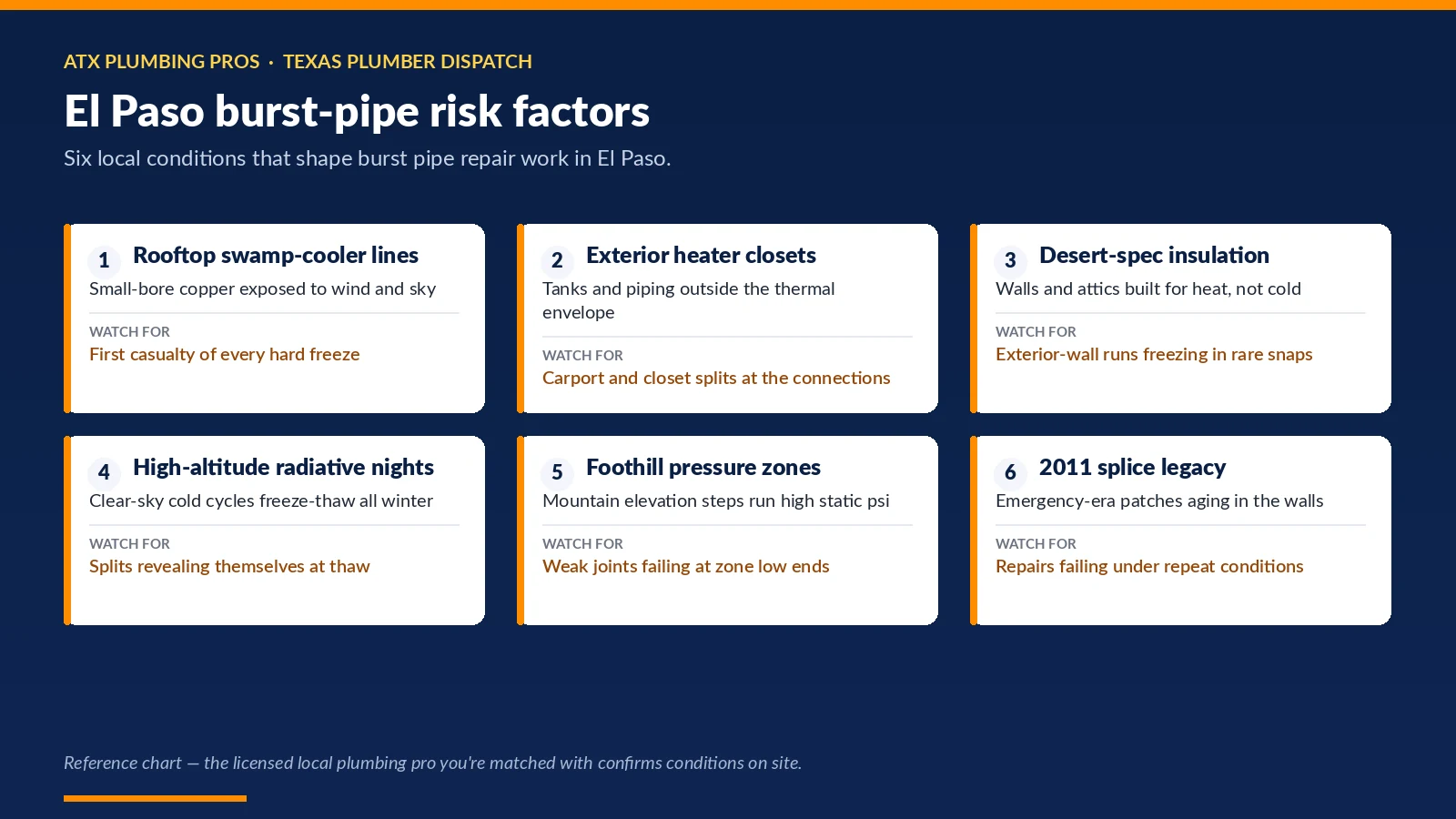
El Paso burst-pipe risk factors, mapped
Six local conditions decide where and when El Paso pipes burst:
| Local factor | What it does to plumbing | What to watch for |
|---|---|---|
| Rooftop swamp-cooler lines | Small-bore copper exposed to wind and sky | First casualty of every hard freeze |
| Exterior heater closets | Tanks and piping outside the thermal envelope | Carport and closet splits at the connections |
| Desert-spec insulation | Walls and attics built for heat, not cold | Exterior-wall runs freezing in rare snaps |
| High-altitude radiative nights | Clear-sky cold cycles freeze-thaw all winter | Splits revealing themselves at thaw |
| Foothill pressure zones | Mountain elevation steps run high static psi | Weak joints failing at zone low ends |
| 2011 splice legacy | Emergency-era patches aging in the walls | Repairs failing under repeat conditions |
Which El Paso areas does the dispatch line cover?
Independent licensed plumbers in the network take dispatch calls across El Paso, including:
El Paso burst-pipe questions, answered straight
Water is coming through the ceiling under my swamp cooler. What do I do?
Close the cooler line’s supply valve first — it is usually a small ball or saddle valve where the line tees off the house supply, often near the water heater or a hose bib. That isolates the burst while the house keeps water. If you cannot find it, use the main shutoff. Then open the cooler line’s drain if it has one, photograph the damage for insurance, and get a plumber dispatched — rooftop line repairs are quick, but the ceiling needs drying assessment.
Why did the pipe burst on a sunny afternoon, days after the cold?
Because ice split it during the freeze and then sealed the split until thaw. Frozen water expands about nine percent, cracking the pipe while the plug still blocks flow; when afternoon sun melts the plug, city pressure finds the opening. This thaw-lag is why El Paso’s burst calls cluster on the warm day after a cold night — and why every line that froze deserves inspection even if it has not leaked yet.
Is my house really at risk if El Paso winters are usually mild?
That mildness is exactly the risk. Because hard freezes are rare, the housing stock carries no defense — exterior heaters, rooftop lines, thin insulation — so the freeze that would inconvenience Amarillo devastates here. Add high-altitude clear-sky nights that dip below freezing all winter, and exposed lines cycle freeze-thaw dozens of times a season. The 2011 event proved the ceiling; the annual small splits prove the floor.
What should I do before a forecast hard freeze?
Run the desert winterization list: drain the swamp-cooler supply line, disconnect hoses and cover bibs, drip faucets served by exterior-wall runs, open cabinets on those walls, verify the main shutoff turns, and if you have an exterior heater closet, check its piping is sleeved. If a multi-day event with outage risk is forecast, know that a fully drained house cannot burst — the shutoff-and-drain drill takes fifteen minutes and beats any repair.
The burst was repaired years ago during a freeze. Should I worry about the patch?
Reasonably, yes. Emergency splices made mid-crisis — compression fittings on frozen copper, mixed materials, no insulation added — are common in El Paso’s 2011 cohort, and they fail under the same conditions that created them. Ask a plumber to look whenever a wall is open or the system is being worked on anyway; upgrading a suspect patch to a proper repair with insulation is minor work compared to meeting it again mid-freeze.
More El Paso plumbing searches
Start from the El Paso city guide for the full local picture, or jump straight to the search that matches your problem. The full service directory covers every guide on the site.
Ceiling stain spreading, or a rooftop line letting go at thaw?
Get the water stopped — cooler valve, house valve or curb stop — then describe what burst and where in El Paso, and the line matches you with an independent TSBPE-licensed plumber who repairs the split, tests the rest of the circuit, and hardens it against the next snap. 24/7.
Austin Plumbing Pros is a dispatch and referral service, not a licensed plumbing contractor. All work is performed by independent Texas-licensed (TSBPE) plumbers who hold their own license, insurance and bond. Availability varies by area and time of day.