Water heater repair in McAllen — Rio Grande minerals in the tank, no-freeze design in the walls, and a Valley that remembers February 2021.
The Rio Grande Valley runs its water heaters on the river — literally. McAllen’s supply is drawn from the Rio Grande, and by the time that water has crossed half a continent it carries a mineral load that puts the Valley firmly in hard-water country: scale on tank floors, crusted elements, anodes consumed ahead of schedule. Around the tank, the housing tells a warm-climate story — heaters in garages, carports, outdoor closets and utility sheds, plumbed by a building culture that rationally never planned for ice. Then came February 2021, when the Valley froze with the rest of Texas and its unprotected installations failed by the thousands in a single week. Repair here means managing the river’s chemistry, respecting the no-freeze architecture’s one weakness, and serving a market of family homes, winter-Texan rentals and rapid new growth. The dispatch line matches McAllen households with independent licensed plumbers who work all of it.
📞 Call (737) 283-6243 — 24/7 Dispatch
One call, no forms, no waiting on callbacks. Describe the problem, and the line matches you with an independent licensed plumber serving McAllen — nights, weekends and holidays included. By calling, you consent to be connected with an independent licensed plumbing company serving your area.
Quick answer: McAllen water heater trouble — slow recovery, rumbling, tripped elements, rusty draws — usually traces to Rio Grande mineral scale, spent anodes, or 2021-legacy stress on outdoor installations. Call (737) 283-6243, 24/7. The line matches you with an independent TSBPE-licensed plumber across McAllen, Edinburg, Mission and Pharr who repairs honestly and prices replacement straight when the tank is done.
What does Rio Grande water do to a Valley water heater?
Loads it with the river’s cargo. Rio Grande water arrives carrying the dissolved minerals of its entire journey, and the Valley’s treatment plants deliver it potable but hard — hardness plus total dissolved solids that put McAllen’s taps among the more mineral-heavy in Texas. Inside a tank, the mechanism is the standard one at elevated tempo: heat precipitates minerals onto the floor and elements, the scale bed insulates burner from water, and the heater works longer for less — rumbling gas tanks, electric elements crusting until they overheat and trip or burn out, recovery times stretching as the sediment deepens.
The anode loses early here too: mineral-heavy water consumes sacrificial rods years ahead of the brochure, and once a rod is spent the tank corrodes in its place — silently, until rusty hot-side draws or a damp ring announce late-stage news. The Valley’s repair economics follow: flushes belong on an annual rhythm (semi-annual for big households running the tank hard), anode checks ride along with every flush, and electric heaters — a large share of Valley installs — benefit doubly, because descaled elements stop cycling against their thermostats.
Softening changes the Valley math the way it does in San Antonio: a point-of-entry softener removes the accelerant, stretches tank life back toward design numbers, and protects the fixtures and appliances downstream. In a region where the same water also feeds ice makers, evaporative coolers and pool equipment, the treatment conversation tends to pay for itself across the whole house — and for tankless owners it is close to mandatory, because Rio Grande minerals close a heat exchanger’s passages on a schedule that annual descaling alone strains to hold.
Why did 2021 hit the Valley’s heaters so hard — and what changed?
Because nothing here was defended — rationally. The Valley’s building culture put water heaters in carports, exterior closets, garages and sheds, ran supply lines through uninsulated exterior walls and open under-slab crawl paths, and skipped freeze protection entirely, because a hard freeze in McAllen is a once-a-decade curiosity. February 2021 was the exception that collected: consecutive nights in the twenties with wind, rolling outages that killed what little heat there was, and burst heater connections, split supply lines and dead tanks across every city in the Valley in a single week — with plumbing crews backlogged for a month after.
The 2021-legacy stock is a live repair category: connections spliced under emergency conditions with whatever fittings the week had left, tanks that survived visibly but took freeze stress at their fittings and glass lining, and a scattering of installations never quite restored right. When a Valley heater with a 2021 history misbehaves — weeping at the splices, pilot trouble since the event, a shell seam showing rust lines — the honest inspection reads the whole installation, not just the symptom, and upgrades the emergency-era work while access is open.
What changed in practice is modest and cheap, and worth keeping: insulating sleeves on the exposed few feet of supply and hot-out piping at outdoor installations, heat tape where a closet or carport run is genuinely exposed, the drip-a-hot-tap drill on the rare freeze forecast, and shutoff literacy — the heater’s cold-inlet valve and the house main, located and exercised before the next exception arrives. The Valley does not need Panhandle winterization; it needs ten dollars of pipe sleeve at the six vulnerable feet every installation has.
How does the Valley’s market shape water-heater work?
Three household types, three workflows. Family homes — McAllen, Edinburgh-adjacent neighborhoods, Mission and Pharr’s established blocks — run the standard arc: repair-versus-replace decisions on aging tanks, sizing conversations as households grow, and the hard-water maintenance rhythm above. New growth — the subdivisions filling north McAllen and Edinburg at metroplex pace — adds the cohort pattern: builder-grade units installed tract by tract, aging in waves, with the first big failure season now arriving in the 2000s-era phases; one street’s dead heater is the block’s forecast.
Winter Texans add the Valley’s signature seasonality. Tens of thousands of seasonal residents mean rental units, park models and second homes that sit empty half the year — and empty-house plumbing has its own failure genre: heaters left energized on stagnating tanks, small leaks running unwitnessed for months, and October arrival days that double as discovery days. The rhythm rewards a departure-and-arrival protocol: water off and heater down (or on vacation mode) at departure; on return, tank verified full before power or gas goes to it, hot taps run until air clears, and a quick look at connections before the season starts. Property managers who batch those turn-on visits through dispatch get them done in routes instead of emergencies.
And replacement decisions carry the Valley’s specific inputs: electric-versus-gas balance (electric dominates more here than most of Texas — element and thermostat repairs are the bread-and-butter call), outage behavior weighed post-2021, outdoor-rated placement and strapping where units live exposed, and permits pulled correctly across McAllen, Edinburg, Mission and Pharr’s separate counters. An independent licensed plumber who works the Valley daily carries all four in his head — which is precisely the match the line makes.
What else does the line cover in the Valley?
Every card below links to a detailed service guide — what the work involves, what drives the effort, and what to check before anyone arrives. The dispatch line covers all of it for McAllen.
24/7 Emergency Plumbing
Burst pipes, active leaks, sewage backups — the line answers around the clock and routes you to a licensed plumber on call.
Water Heater Repair
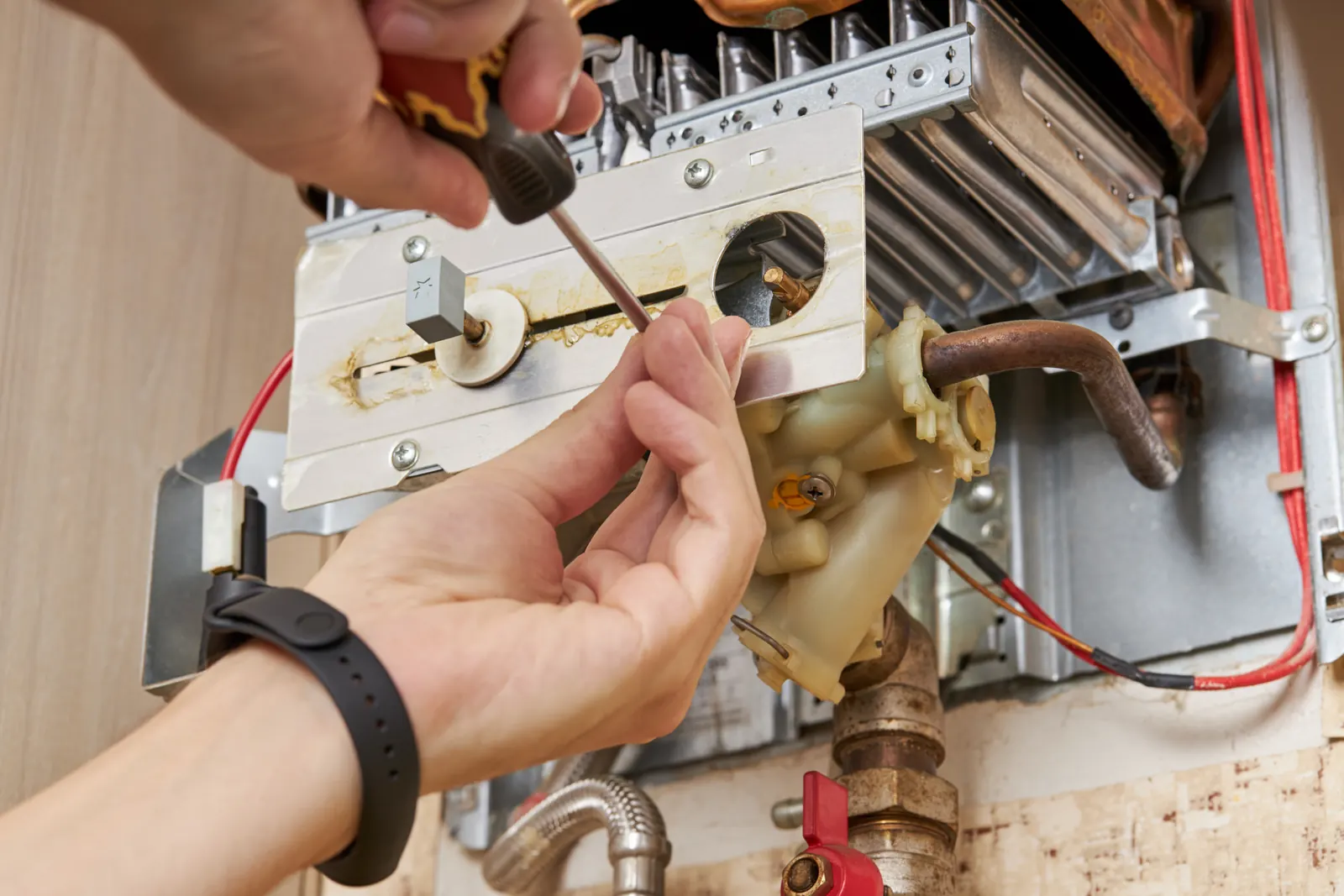
Tank and tankless diagnosis — no hot water, pilot failures, sediment noise, leaking T&P valves.
Drain Cleaning
Snaking, hydro-jetting and camera scoping for kitchen, shower and mainline clogs.
Leak Detection
Acoustic and thermal location of hidden leaks before they become demolition projects.
Slab Leak Detection
Under-slab pinpointing so the plumber opens one spot in the foundation, not five.
Sewer Line Repair
Camera-verified diagnosis, trenchless lining and pipe bursting where the ground allows.
Tankless Water Heaters
Sizing, gas-line checks and descaling schedules matched to local water hardness.
Water Softener Installation
Grain-capacity sizing based on the hardness that actually comes out of local taps.
McAllen water-heater risk factors, mapped
Six local conditions decide how Valley water heaters live and die:
| Local factor | What it does to plumbing | What to watch for |
|---|---|---|
| Rio Grande mineral load | River water runs hard and TDS-heavy | Scale beds, crusted elements, early anodes |
| Outdoor installations | Carports, closets and sheds, unprotected | One exposed run per house, every house |
| 2021 freeze legacy | Emergency splices and stressed tanks | Whole-installation inspections warranted |
| Electric-heavy stock | Elements and thermostats dominate repairs | Descaling doubling element lifespan |
| Winter-Texan seasonality | Half-year vacancies and turn-on days | Departure/arrival protocols preventing losses |
| Growth-wave cohorts | 2000s+ tracts aging in unison | First failure seasons arriving now |
Which McAllen areas does the dispatch line cover?
Independent licensed plumbers in the network take dispatch calls across McAllen, including:
McAllen water-heater questions, answered straight
My electric heater keeps tripping its breaker or running lukewarm. What is that?
The classic Valley element story: Rio Grande minerals crust electric elements until they overheat — tripping high-limit switches, burning out, or heating so inefficiently the tank never fully recovers. The repair is straightforward (elements and thermostats are inexpensive parts), but the fix that lasts pairs it with a proper flush, because new elements in a sediment-loaded tank crust again on the same schedule. Chronic repeats are the softener conversation announcing itself.
We are winter Texans. How should we leave the water heater in April?
Water off at the main, heater off or on its vacation setting — gas pilots can stay per manufacturer guidance, electric should be de-energized — and a note on the panel reminding whoever returns first of the sequence: water on, tank verified full (hot taps run until air stops), then power or gas restored. That order matters; energizing elements in a partially drained tank destroys them in seconds. Property managers can batch the October turn-ons through the line as scheduled routes.
Is our water really that hard if it comes from a river, not wells?
Yes — the Rio Grande gathers mineral load across its whole basin, and Valley municipal water lands solidly in hard territory with high dissolved solids besides. The evidence is in every kettle and showerhead in McAllen. For heaters it means the full program: annual flushes, anode checks, descaled elements — and a genuine payback case for point-of-entry softening, which slows the entire cycle and protects the rest of the house’s appliances along the way.
Do I need to freeze-protect a water heater in McAllen, seriously?
Ten dollars’ worth, yes. The Valley’s installations are outdoors by design, and 2021 proved what one exceptional week does to unprotected carport and closet units — thousands failed in days. The protection is trivial: foam sleeves on the exposed supply and hot-out runs, heat tape on genuinely exposed sections, and the drip-a-hot-tap drill on the rare hard-freeze forecast. It is the lowest-effort insurance in Valley plumbing precisely because the exposure is so concentrated.
The heater survived 2021 but has not been right since. Worth repairing?
Have the whole installation read, not just the complaint. Freeze events stress tanks at their fittings and glass lining, and emergency-week repairs spliced in under duress are now aging in place — a unit that has ‘not been right since’ often carries both. If the shell is sound, upgrading the stressed connections and servicing the tank restores it honestly; if rust lines or seam moisture show, the 2021 stress likely shortened its remaining life, and the replacement math deserves straight numbers before more repair money follows.
More McAllen plumbing searches
Start from the McAllen city guide for the full local picture, or jump straight to the search that matches your problem. The full service directory covers every guide on the site.
Lukewarm showers, a tripping element, or an October turn-on gone wrong?
Describe the heater — gas or electric, where it lives, any 2021 history — and the line matches you with an independent TSBPE-licensed plumber who works McAllen, Edinburg, Mission and Pharr every week. 24/7 dispatch, winter-Texan schedules understood.
Austin Plumbing Pros is a dispatch and referral service, not a licensed plumbing contractor. All work is performed by independent Texas-licensed (TSBPE) plumbers who hold their own license, insurance and bond. Availability varies by area and time of day.