Hydrostatic plumbing tests in Houston — the ten-day option period’s most consequential twenty minutes.
No Texas city runs more hydrostatic tests than Houston, and no city has better reasons. The housing stock’s middle generation — the vast 1950s–70s slab neighborhoods — carries original cast-iron drains under the concrete, sixty-plus years into a service life Houston’s soil and water actively shorten. Gumbo clay flexes the lines, subsidence has re-graded whole districts, and foundation leveling — a Houston ritual in itself — can shear a drain in the very act of fixing the floor. The hydrostatic test is how buyers, sellers and foundation crews find out what the slab is hiding: plug the system, fill it to floor level, and watch whether the water holds. The dispatch line matches Houston homeowners, buyers and agents with independent licensed plumbers who run the test and read it honestly.
📞 Call (737) 283-6243 — 24/7 Dispatch
One call, no forms, no waiting on callbacks. Describe the problem, and the line matches you with an independent licensed plumber serving Houston — nights, weekends and holidays included. By calling, you consent to be connected with an independent licensed plumbing company serving your area.
Quick answer: A hydrostatic test plugs your sewer system at the cleanout, fills the drain lines with water to slab level, and watches the level for 15–20 minutes — a drop means the under-slab plumbing is leaking. In Houston it is standard due diligence during option periods and before and after foundation leveling — call (737) 283-6243 and the line matches you with an independent TSBPE-licensed plumber who tests, cameras and explains the result 24/7.
What does a hydrostatic test actually measure — and what can it not tell you?
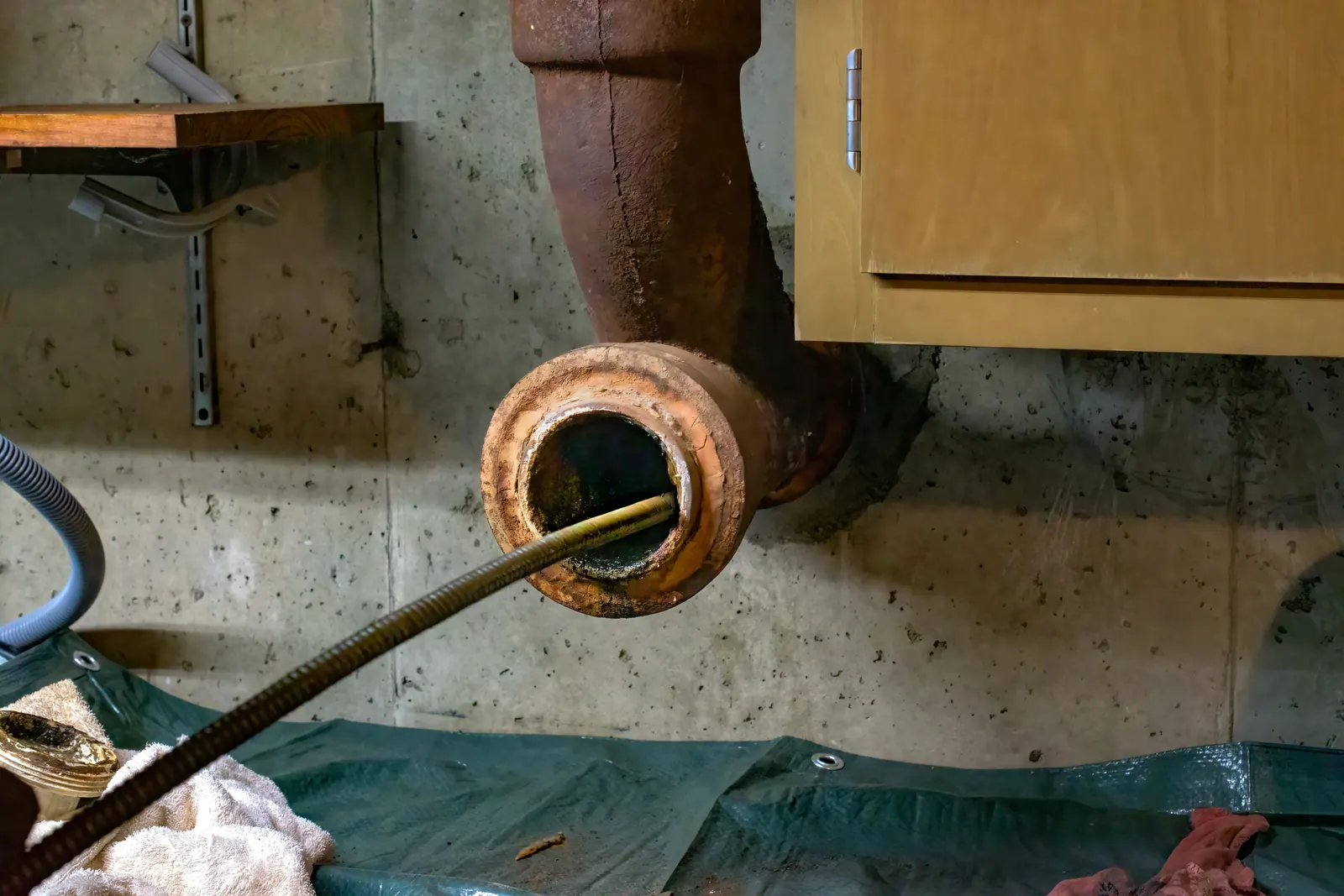
The test is elegantly simple. A licensed plumber inserts an inflatable test ball into the sewer line at the exterior cleanout and seals the system where it leaves the house. The drain lines are then filled with water up to slab level — the height of the lowest fixture — and the water level is watched, typically for fifteen to twenty minutes. Sound pipe holds the column exactly where it started. A falling level means water is leaving the system somewhere under or inside the slab: a cracked hub, a channeled cast-iron bottom, a joint the clay pulled apart.
What the test cannot do is point to the leak. A failed hydrostatic test says that the system leaks and roughly how fast — a slow creep and a rapid drop are different conversations — but not where. Locating comes next: isolation testing plugs the system in segments to bracket the failing section, and a camera pass reads the pipe from inside. In Houston’s 1950s–70s belt the camera often settles it quickly, because bottom-channeled cast iron photographs unmistakably.
It is worth naming what a passing test means, too: the drain system held water on that day, under static conditions. It is a strong signal — the standard one Houston real estate runs on — but it is not a warranty against the next decade of gumbo movement. That is why the test is a snapshot tool deployed at decision moments: purchases, leveling, remodels — the moments when what is under the slab is about to become your problem.
Why is this test a Houston real-estate ritual?
Because the math is brutal and local. A buyer closing on a 1962 Meyerland or Sharpstown slab home is buying whatever the cast iron under it has become, and repairs under a slab — tunneling crews, days of digging, engineered backfill — are among the largest surprise costs in Texas homeownership. A twenty-minute test during the ten-day option period is the smallest insurance line in the whole transaction. Listing agents in the under-slab cast-iron belt increasingly order it pre-listing, because a documented passing test is a selling point and a failed one found early is negotiable instead of catastrophic.
Foundation repair is the other trigger, and Houston does more of it than almost anywhere. Leveling a slab means lifting a structure that the drain lines are bedded under — and lines that survived decades of gradual settlement do not always survive being pushed back. The professional sequence is test before, level, test after: the before-test establishes whether the plumbing was already leaking (and documents it), the after-test catches what the lift sheared. Skipping the before-test is how leveling companies and homeowners end up arguing about whose leak it is.
There is also a quieter, growing use: pre-remodel testing. Post-Harvey Houston has renovated at enormous scale, and a kitchen or bath remodel that pours new finishes over an untested 1955 drain system is stacking new money on old risk. Testing first costs little; discovering a channeled line after the new tile is down costs the tile too.
The test failed. What actually happens next in a Houston house?
First, nobody should panic-buy a repair on the strength of the drop alone. The follow-up sequence exists precisely to size the problem: isolation testing brackets which segment is losing water — sometimes it is a single bathroom group, not the whole system — and the camera establishes what the pipe is and what condition it is in. A hairline loss in one hub is a different project from a system-wide channeled line, and the honest quote is written off the footage, not off the fear.
Repair paths in Houston sort into three families. Spot repair reaches one failed section — under an accessible edge, through a tunnel, or occasionally through the slab — and makes sense when the rest of the line photographs sound. Tunneling replaces longer runs while the family stays in the house, with crews excavating beneath the foundation; it is the workhorse method in the cast-iron belt. And re-lining or full replacement enters the conversation when the camera shows systemic failure — with the important Houston honesty note that lining needs a pipe with a bottom left to line, which badly channeled cast iron may not have.
Two structural notes matter locally. Post-tension slabs — standard in Houston’s newer rings — carry steel cables that make cutting the slab a specialist decision, pushing repairs toward tunneling. And any under-slab drain work in the city of Houston requires permits and inspection; in a market this size, the permit trail is also the next buyer’s proof that the work was real. An independent licensed plumber walks all of this — findings, paths, permits — before anything is signed.
What else does the line cover in Houston?
Every card below links to a detailed service guide — what the work involves, what drives the effort, and what to check before anyone arrives. The dispatch line covers all of it for Houston.
24/7 Emergency Plumbing
Burst pipes, active leaks, sewage backups — the line answers around the clock and routes you to a licensed plumber on call.
Water Heater Repair
Tank and tankless diagnosis — no hot water, pilot failures, sediment noise, leaking T&P valves.
Drain Cleaning
Snaking, hydro-jetting and camera scoping for kitchen, shower and mainline clogs.
Leak Detection
Acoustic and thermal location of hidden leaks before they become demolition projects.
Slab Leak Detection
Under-slab pinpointing so the plumber opens one spot in the foundation, not five.
Sewer Line Repair
Camera-verified diagnosis, trenchless lining and pipe bursting where the ground allows.
Tankless Water Heaters
Sizing, gas-line checks and descaling schedules matched to local water hardness.
Water Softener Installation
Grain-capacity sizing based on the hardness that actually comes out of local taps.
Houston hydrostatic-testing risk factors, mapped
Six local conditions make Houston the hydrostatic-testing capital of Texas:
| Local factor | What it does to plumbing | What to watch for |
|---|---|---|
| Under-slab cast iron (’50s–’70s) | Sixty-plus years of bottom channeling | Failed tests clustering in mid-century belts |
| Gumbo clay movement | Wet-dry cycles work every buried joint | Slow-creep failures after drought summers |
| Subsidence history | Whole districts re-graded over decades | Bellies and reversed fall on camera |
| Foundation leveling | Lifting the slab can shear bedded drains | Test-before-and-after as standard practice |
| Option-period clock | Ten days to find what the slab hides | Same-week test scheduling during sales |
| Post-tension slabs (newer rings) | Cables complicate cutting the slab | Repairs routed through tunnels instead |
Which Houston areas does the dispatch line cover?
Independent licensed plumbers in the network take dispatch calls across Houston, including:
Houston hydrostatic-test questions, answered straight
How long does a hydrostatic test take, and is it invasive?
Plan on one to two hours on site: locating and opening the cleanout, setting the test ball, filling the system and observing the level for 15–20 minutes, then draining down. Nothing is cut or dug — the test uses the plumbing’s existing access. Houses without a usable exterior cleanout may need one installed or a toilet pulled for access, which the plumber will flag before starting.
Can a hydrostatic test damage my old pipes?
This question comes up because a failed test sometimes gets blamed on the test itself. The water column only recreates the static condition the system already experiences when a line backs up — it adds no pressure beyond the height of the slab. Pipe that fails under a hydrostatic test was already leaking or on the edge of it; the test revealed the condition, it did not create it. A licensed plumber will also decline to test a system with known active collapse.
Should I test during my option period even if the house seems fine?
On slab homes from Houston’s 1950s–70s belt, emphatically yes — under-slab cast iron at this age can leak for years without a visible symptom, because the water goes into the soil, not onto the floor. The test is a small line item against the largest hidden-repair category in the market. On newer PVC-drained homes the odds are better, but leveling history, big trees, or any drainage oddity still argues for the twenty minutes.
The seller already has a passing test from a few months ago. Is that enough?
A recent documented test from a licensed plumber carries real weight — ask for the report and who ran it. Whether it is enough depends on what has happened since: a drought cycle, foundation work, or months of vacancy can change the picture. Many buyers accept a recent pass; many order a fresh test anyway given what is at stake. Either way, the report should name the method, duration and result, not just say it passed.
My test failed but the drop was slow. Do I have to fix it right now?
A slow static loss in a house that is functioning normally is a planning problem, not a tonight problem — but it is a real problem, because gumbo movement only pushes one direction. The next step is cheap relative to guessing: isolation testing and a camera pass to find out which segment is failing and how badly. With that in hand you can scope, budget, negotiate or phase the repair deliberately — which is the entire advantage of finding it under static test conditions instead of as a slab leak.
More Houston plumbing searches
Start from the Houston city guide for the full local picture, or jump straight to the search that matches your problem. The full service directory covers every guide on the site.
Option period ticking, or leveling crew scheduled?
Say where the house is and what decision the test feeds — purchase, foundation work or remodel — and the line matches you with an independent TSBPE-licensed plumber who runs the test, cameras what fails, and gives you the result straight. 24/7 dispatch.
Austin Plumbing Pros is a dispatch and referral service, not a licensed plumbing contractor. All work is performed by independent Texas-licensed (TSBPE) plumbers who hold their own license, insurance and bond. Availability varies by area and time of day.