Tankless water heaters in Fort Worth — one technology, three completely different installations depending on which Fort Worth you live in.
Fort Worth is really three housing markets wearing one name, and tankless conversion means something different in each. In the coal-era near south side — Fairmount, Ryan Place, Mistletoe Heights — the old tank vents up a masonry chimney, and going tankless means engineering a whole new venting and gas path through a 1920s structure. In the mid-century ring, the tank lives in a garage that a February norther turns into an icebox, and the conversion is mostly about freeze discipline. And in the Alliance corridor’s newer stock, tankless is already on the wall — the work is keeping a hard-working unit descaled and correctly sized. The dispatch line matches Fort Worth homeowners with independent licensed plumbers who install and service all three.
📞 Call (737) 283-6243 — 24/7 Dispatch
One call, no forms, no waiting on callbacks. Describe the problem, and the line matches you with an independent licensed plumber serving Fort Worth — nights, weekends and holidays included. By calling, you consent to be connected with an independent licensed plumbing company serving your area.
Quick answer: Tankless conversion in Fort Worth turns on three questions: can the gas line feed a 150,000–199,000 BTU burner (usually an upsizing conversation with the meter), where does the new sealed venting run (a real project in chimney-vented older homes), and how will the unit survive a norther (freeze protection needs electricity). Call (737) 283-6243 — the line matches you 24/7 with an independent TSBPE-licensed plumber who sizes, installs and services tankless across Fort Worth.
What changes between a tank and a tankless in Fort Worth’s housing stock?
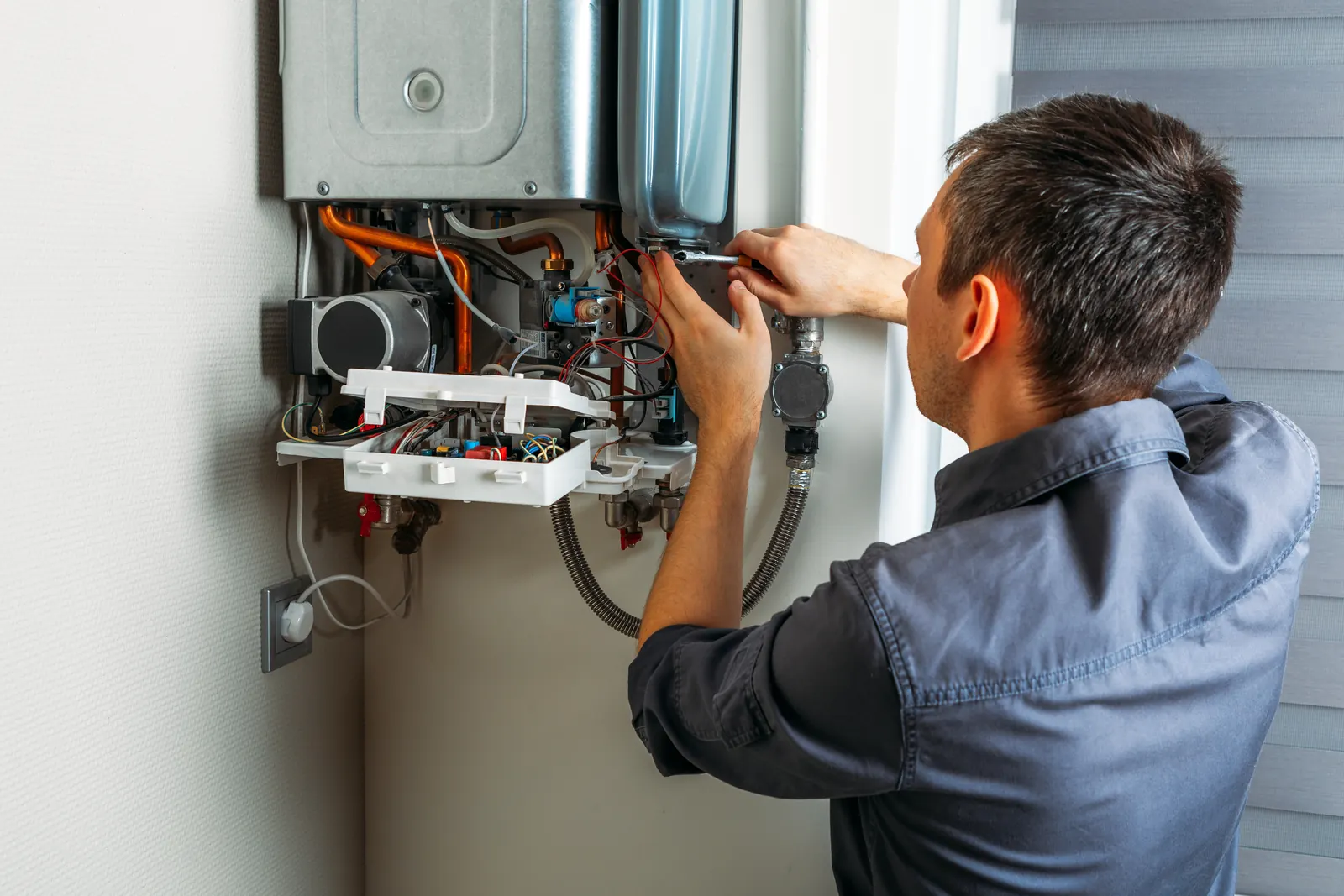
Start with the appetite. A tank heater sips gas at 30–40,000 BTU and stores the result; a tankless drinks at 150–199,000 BTU on demand and stores nothing. Most Fort Worth homes were piped for the sipper — a half-inch branch that has fed the tank happily since the house was built cannot feed a tankless at full fire. Conversion therefore usually includes a gas conversation: larger-diameter runs from the meter, and where the whole house’s load has crept up (generator, gas range, pool heater), an Atmos meter upsizing. This is normal, planned-for work — but a quote that skips the gas math is a quote for an underperforming unit.
Venting is the second rewrite. Tanks in older Fort Worth vent by draft — hot exhaust rising through metal flue into masonry chimney — and the near south side’s 1910s–40s houses were literally built around those chimneys. A condensing tankless vents horizontally in sealed PVC, which is safer and more efficient, but it means abandoning the chimney path and penetrating a wall — in a historic district, on a house with wood siding and deep eaves, that is a routing decision worth an experienced eye. Mid-century ranches with garage tanks are simpler: the vent usually exits the garage wall within a few feet.
The third rewrite is expectations. Tankless delivers endless hot water at a fixed flow ceiling — it will run three showers forever or four never, depending on the size chosen. Fort Worth’s winter inlet water runs cold enough (into the 40s°F) that a unit sized on summer numbers loses a shower’s worth of capacity in January. Sizing to winter inlet, real fixture count and actual family rhythm is the difference between a conversion people rave about and one they quietly regret.
What does a Fort Worth norther do to a tankless — and how is it prevented?
The 2021 freeze wrote this section. Tankless units mount on or through exterior walls, and their heat exchangers hold a small volume of water that freezes fast in a wind-driven cold snap — Fort Worth’s position on the open plains gives its northers a wind-chill bite Dallas rarely matches. Modern units carry built-in freeze-protection heaters… which run on electricity. February 2021’s combination — deep cold plus rolling blackouts — killed exchangers across the city precisely because the protection died with the power. A dead exchanger is the most expensive single part on the unit.
Prevention is a checklist, not a product. Exterior and recessed-box units want their supply lines insulated and heat-taped ahead of the season. Every tankless install should include accessible isolation valves with drain ports — sixty seconds with those valves drains the exchanger before a forecast blackout, and that one habit is the difference between a normal February and a four-figure one. Units in garages want the garage door shut and the unit’s recess sealed against wind. And homes with standby generators should have the tankless’s freeze protection on the covered circuit list.
Placement judgment upstream of all this is what a Fort Worth-experienced installer brings: on the west side’s exposed lots, an interior mechanical wall or garage placement beats a north-facing exterior mount; in the older districts, the venting path and the freeze calculus get solved together. The unit’s brochure is climate-agnostic; the install should not be.
What does ongoing tankless service look like here?
Descaling, mostly — and Fort Worth’s water makes it a real schedule. City water off the Trinity system runs moderately hard (commonly 7–10 grains), which is gentler than San Antonio’s rock but plenty to coat a heat exchanger’s narrow passages over a year or two of duty. The symptom arc is familiar: the unit runs longer to hit temperature, flow oscillates warm-cool-warm, and eventually error codes land. An annual (or in harder-water pockets, semi-annual) vinegar-or-descaler flush through those isolation valves restores the exchanger — twenty minutes of service that the no-valve install turns into a plumbing job.
Newer-stock owners in the Alliance corridor and the far-north cohorts inherit builder-grade tankless units now aging into their first real service decade. The cohort logic that governs everything in production-built neighborhoods applies: units installed street-by-street in the same season hit descale age, sensor failures and exchanger fatigue on the same calendar. When a neighbor’s unit starts throwing codes, it is a reasonable prompt to book your own service — the water and the workload are identical.
And the honest replacement conversation: a tankless that has been descaled on schedule genuinely reaches its 15–20 year design life; one that has never been flushed in this water often costs more to resurrect at year ten than to replace. Meanwhile, tank owners converting at end-of-life should hear the whole picture — the conversion’s gas and venting work is real, the endless-hot-water and space gains are real, and the right answer differs house to house. An independent licensed plumber with no inventory to move can run both numbers straight.
What else does the line cover in Fort Worth?
Every card below links to a detailed service guide — what the work involves, what drives the effort, and what to check before anyone arrives. The dispatch line covers all of it for Fort Worth.
24/7 Emergency Plumbing
Burst pipes, active leaks, sewage backups — the line answers around the clock and routes you to a licensed plumber on call.
Water Heater Repair
Tank and tankless diagnosis — no hot water, pilot failures, sediment noise, leaking T&P valves.
Drain Cleaning
Snaking, hydro-jetting and camera scoping for kitchen, shower and mainline clogs.
Leak Detection
Acoustic and thermal location of hidden leaks before they become demolition projects.
Slab Leak Detection
Under-slab pinpointing so the plumber opens one spot in the foundation, not five.
Sewer Line Repair
Camera-verified diagnosis, trenchless lining and pipe bursting where the ground allows.
Tankless Water Heaters
Sizing, gas-line checks and descaling schedules matched to local water hardness.
Water Softener Installation
Grain-capacity sizing based on the hardness that actually comes out of local taps.
Fort Worth tankless risk factors, mapped
Six local conditions decide how a tankless install goes in Fort Worth:
| Local factor | What it does to plumbing | What to watch for |
|---|---|---|
| Chimney-vented older homes | Sealed venting must replace masonry draft path | New wall penetrations in historic districts |
| Undersized legacy gas runs | Tankless burners draw 4–6× a tank’s BTU | Atmos meter and line upsizing conversations |
| Wind-driven northers | Exchangers freeze fast in exposed mounts | Isolation-valve drain-down before blackouts |
| Power-dependent freeze protection | Built-in heaters die with the grid | 2021-pattern exchanger losses citywide |
| Winter inlet in the 40s°F | Cold inlet cuts real-world flow capacity | Sizing to January, not July |
| Moderately hard Trinity water | 7–10 grains coats heat exchangers | Annual descale through service valves |
Which Fort Worth areas does the dispatch line cover?
Independent licensed plumbers in the network take dispatch calls across Fort Worth, including:
Fort Worth tankless questions, answered straight
Can my 1920s Fairmount house even go tankless?
Yes — with a plan. The old tank likely vents up the chimney, so the conversion engineers a new sealed vent path through an exterior wall, plus a gas-line assessment for the bigger burner. On pier-and-beam structures the routing is often friendlier than it sounds, and historic-district exterior rules reward an installer who has done this before. Done properly, the house gains closet space and loses nothing.
Will a tankless keep up with my family in winter?
If it was sized for winter, yes. Fort Worth inlet water drops into the 40s°F in cold months, and heating colder water costs flow — a unit that ran three showers in August may hold two in January if it was sized on summer math. The fix is buying capacity against winter inlet temperature and your real simultaneous use, or twinning units for big households. This is arithmetic an installer should show you, not assert.
How do I keep a freeze from killing the unit?
Three layers: insulate and heat-tape exposed supply lines before the season; keep the unit’s built-in freeze protection powered (it is electric — a generator circuit or a plan for outages matters); and know your isolation valves. When a hard freeze plus possible blackout is forecast, closing the valves and opening the drain ports empties the exchanger in about a minute. That drill is what separated intact units from dead ones in February 2021.
Does Fort Worth water require descaling a tankless?
Yes, on a real schedule — Trinity-system water runs moderately hard, and the exchanger’s narrow passages collect scale the way a kettle does. An annual flush with descaling solution through the isolation valves keeps efficiency and flow where they belong; harder-water pockets and high-use households may want it twice a year. Units installed without service valves should have them added at the first service — it converts every future flush from a project to a chore.
Is converting from a tank worth it, honestly?
It depends what you value. The conversion carries real one-time work — gas upsizing, new venting — that a like-for-like tank swap avoids. In exchange: endless hot water, a reclaimed closet or garage corner, lower standby losses, and a 15–20 year service life against a tank’s 10–12. Households that run out of hot water regularly, or that are re-doing gas or walls anyway, get the clearest win. An independent licensed plumber can price both paths without a thumb on the scale.
More Fort Worth plumbing searches
Start from the Fort Worth city guide for the full local picture, or jump straight to the search that matches your problem. The full service directory covers every guide on the site.
Tank dying anyway, or tired of the third cold shower?
Describe the house — age, where the current heater lives, how many showers run at once — and the line matches you with an independent TSBPE-licensed plumber who sizes for Fort Worth winters, handles gas and venting to code, and sets the unit up to survive February. 24/7.
Austin Plumbing Pros is a dispatch and referral service, not a licensed plumbing contractor. All work is performed by independent Texas-licensed (TSBPE) plumbers who hold their own license, insurance and bond. Availability varies by area and time of day.