Plumbers in Terrell Hills — a square mile of 1920s–50s craftsmanship, incorporated on purpose, plumbed in another era.
Terrell Hills is easy to mistake for a San Antonio neighborhood and legally is nothing of the sort: it is its own incorporated city — its own hall, its own permits, its own inspection standards — a compact grid of custom homes built mostly between the 1920s and 1950s east of Alamo Heights and north of Fort Sam Houston. That vintage sets the plumbing agenda. Original galvanized supply lines are eighty to a hundred years into narrowing shut. Clay-tile laterals thread beneath one of the city’s grandest oak canopies. Edwards Aquifer water at 15–20 grains has spent those same decades etching brass and seizing valves. And nearly every house has been renovated at least twice, layering eras of pipe behind plaster. The dispatch line matches Terrell Hills homeowners with independent licensed plumbers fluent in exactly this stock.
📞 Call (737) 283-6243 — 24/7 Dispatch
One call, no forms, no waiting on callbacks. Describe the problem, and the line matches you with an independent licensed plumber serving San Antonio — nights, weekends and holidays included. By calling, you consent to be connected with an independent licensed plumbing company serving your area.
Quick answer: Terrell Hills plumbing means prewar-to-1950s custom homes: galvanized supply reaching end-of-life, clay laterals under mature oaks, hard-water-etched brass, renovation splices — and permits pulled through the City of Terrell Hills itself, not San Antonio. Call (737) 283-6243, 24/7 — the line matches you with an independent TSBPE-licensed plumber who works this square mile’s specific vintage.
What does eighty-year-old craftsmanship mean for the pipes?
The houses were built beautifully and plumbed to the standards of 1935 — which means galvanized steel supply lines that have now spent the better part of a century rusting shut from the inside. The progression is unmistakable from the fixtures: strong cold and weak hot (the hot side corrodes faster), pressure that collapses when a second tap opens, a rusty tinge in the first morning draw. Every threaded joint in that system is a future weep, and in 15–20 grain water, corrosion and scale work together on a schedule other cities’ galvanized never faces.
Below ground, the laterals are clay tile in short sections, laid under what became one of San Antonio’s great oak canopies — and those two facts are one story. Root systems that have had eighty years to map every joint enter as whiskers and mature into mats; the cycle of cabling, regrowth and re-cabling accelerates each round. The camera decides whether a lateral is a maintenance case (cut roots properly, schedule the clock) or a repair case (joints displaced beyond honest cleaning), and in a city of mature landscaping, camera-guided spot repair and lining-where-qualified beat trenches through heritage gardens.
And everywhere, the water itself. Edwards Aquifer hardness at this duration is a material force: brass valve stems etched and seized, aerators crusting on a monthly rhythm, water heaters running scale beds that halve their lifespan, and the soap-curd scum that narrows old drain runs. Households here tend to know their softener conversation is overdue; the houses that have had one for decades wear their original fixtures visibly better.
How much renovation history is hiding behind the plaster?
Almost a century of it, in layers. Terrell Hills homes have been continuously loved — kitchens redone in every decade’s style, baths added, servants’ quarters converted, additions grafted — and each round of work made its era’s plumbing choices. The result behind the walls is stratigraphy: 1930s galvanized feeding a 1970s copper branch feeding a 2010s PEX manifold, with transition couplings of every vintage at the seams. Those transitions are the system’s weak points — dissimilar-metal connections corrode galvanically, and the oldest segments constrain the whole system’s pressure and flow no matter how new the visible fixtures are.
Diagnosis here is archaeology before it is plumbing. A pressure or flow complaint in a layered house is rarely solved at the fixture; it traces back through which era’s pipe serves that wing, where the splices sit, and which original runs were never actually replaced — just bypassed, abandoned in place, or worse, left half-live. Plumbers who work prewar stock read those layers quickly and know the local pattern: the kitchen got copper in ’74, the primary bath got PEX in 2012, and the hall bath still drinks through 1938 steel.
The renovation lesson cuts forward too. Every Terrell Hills remodel is the cheap moment to retire another stratum — walls open, floors up, trenches dug. The houses that flow like new construction are the ones whose owners used two or three renovation cycles to systematically replace supply, then drains, then the lateral. The ones that still frustrate are the ones where each remodel added finishes over the same 1930s arteries. An independent licensed plumber walking a planned remodel can map exactly which era dies in this round.
What changes because Terrell Hills is its own city?
The paperwork, meaningfully. Plumbing work here permits through the City of Terrell Hills — its own hall, its own fee schedule, its own inspectors — not through San Antonio’s system, and the small-city dynamic cuts both ways: processes are personal and quick when the plumber knows the counter, and conspicuous when they do not. Neighboring Alamo Heights and Olmos Park run the same independent-city pattern, which is why plumbers who work this enclave cluster learn three permit offices as a set. For homeowners the practical takeaway is simple: confirm your plumber pulls Terrell Hills permits as Terrell Hills permits — work filed to the wrong jurisdiction surfaces at resale.
Utilities thread through differently too. Water and sewer service come via SAWS arrangements, so the private-lateral boundary works as it does citywide — the run from house to main is the homeowner’s — while gas service through CPS Energy keeps its meter boundary and its post-repair relight chain. The 2013 sewer consent decree’s logic applies here as everywhere: rebuilt public mains, private laterals aging on their own clock, and camera evidence deciding whose side a failure sits on.
And the neighborhood’s character shapes the work itself: no two houses repeat, so there is no cohort shortcut — every job starts with reading the individual house’s history; landscaping and hardscape are decades mature, pushing sewer work toward minimally invasive methods; and Fort Sam Houston’s adjacency stocks the area with military families and career renters whose landlords want documented, permitted work. It is a square mile that rewards the plumber who treats each address as its own archive — which is precisely the match the dispatch line makes.
San Antonio service guides — the same network covers Terrell Hills
Every card below links to a detailed service guide — what the work involves, what drives the effort, and what to check before anyone arrives. The dispatch line covers all of it for San Antonio.
24/7 Emergency Plumbing
Burst pipes, active leaks, sewage backups — the line answers around the clock and routes you to a licensed plumber on call.
Water Heater Repair
Tank and tankless diagnosis — no hot water, pilot failures, sediment noise, leaking T&P valves.
Drain Cleaning
Snaking, hydro-jetting and camera scoping for kitchen, shower and mainline clogs.
Leak Detection
Acoustic and thermal location of hidden leaks before they become demolition projects.
Slab Leak Detection
Under-slab pinpointing so the plumber opens one spot in the foundation, not five.
Sewer Line Repair
Camera-verified diagnosis, trenchless lining and pipe bursting where the ground allows.
Tankless Water Heaters
Sizing, gas-line checks and descaling schedules matched to local water hardness.
Water Softener Installation
Grain-capacity sizing based on the hardness that actually comes out of local taps.
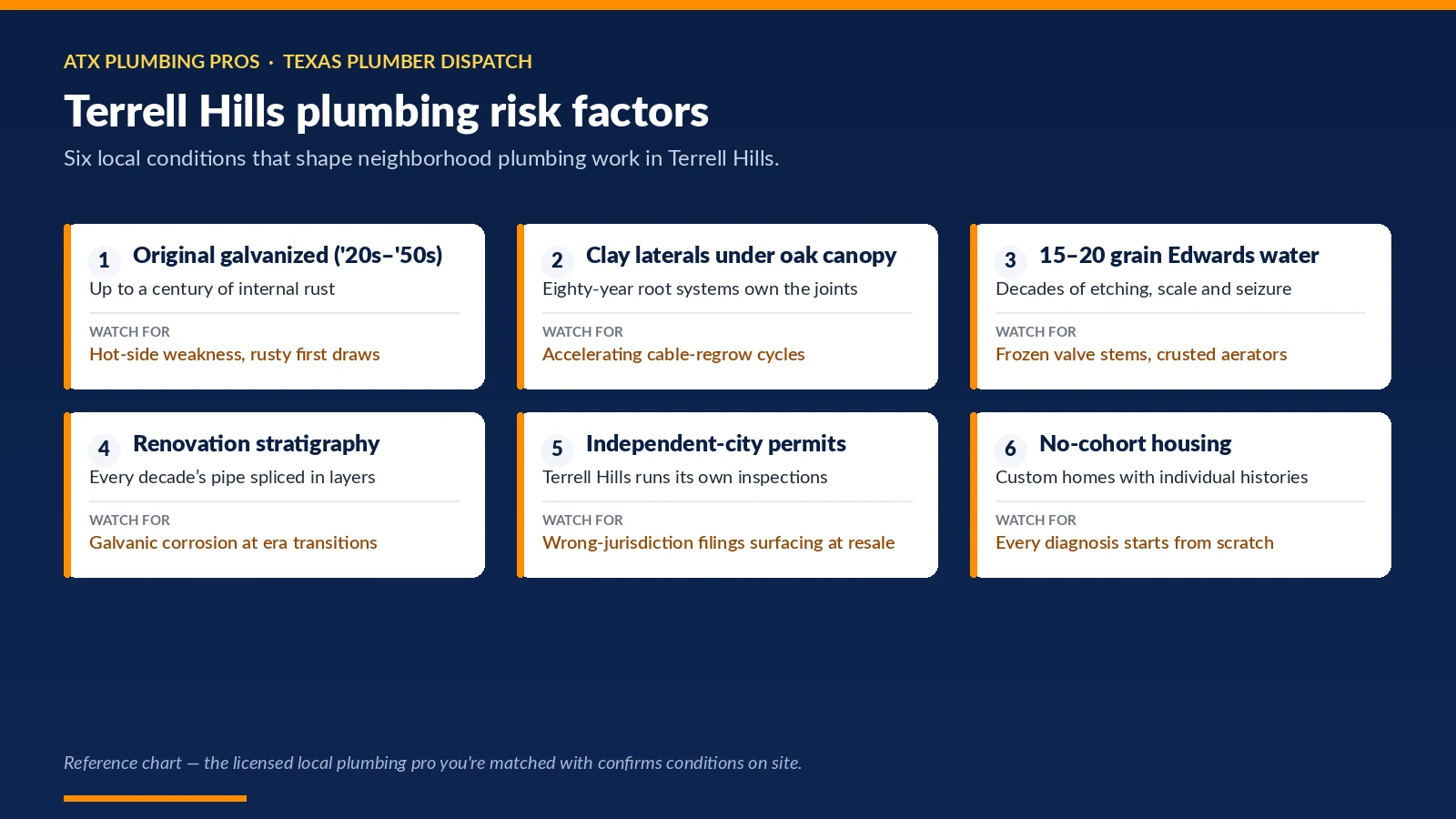
Terrell Hills plumbing risk factors, mapped
Six local conditions define plumbing in this square-mile city:
| Local factor | What it does to plumbing | What to watch for |
|---|---|---|
| Original galvanized (’20s–’50s) | Up to a century of internal rust | Hot-side weakness, rusty first draws |
| Clay laterals under oak canopy | Eighty-year root systems own the joints | Accelerating cable-regrow cycles |
| 15–20 grain Edwards water | Decades of etching, scale and seizure | Frozen valve stems, crusted aerators |
| Renovation stratigraphy | Every decade’s pipe spliced in layers | Galvanic corrosion at era transitions |
| Independent-city permits | Terrell Hills runs its own inspections | Wrong-jurisdiction filings surfacing at resale |
| No-cohort housing | Custom homes with individual histories | Every diagnosis starts from scratch |
Which San Antonio areas does the dispatch line cover?
Independent licensed plumbers in the network take dispatch calls across San Antonio, including:
Terrell Hills plumbing questions, answered straight
Do permits really go through Terrell Hills and not San Antonio?
Yes — Terrell Hills is an incorporated city with its own permitting and inspections, exactly like neighboring Alamo Heights and Olmos Park. Plumbing work of consequence files at the Terrell Hills city offices, and its inspectors sign it off. It matters beyond formality: permits filed to the wrong jurisdiction create title-and-resale headaches later, and local inspectors know this housing stock’s quirks well enough to be genuinely useful.
My hot water pressure is far worse than my cold. Why?
That asymmetry is classic end-stage galvanized. Hot water accelerates internal corrosion, so the hot-side pipes narrow years ahead of the cold — strong cold tap, feeble hot tap is the signature. Cleaning fixtures will not fix it; the bore itself is closing. The honest conversation is replacement scope: sometimes one wing’s runs, often a staged whole-house repipe, ideally timed with any renovation that already opens walls.
Can the sewer be repaired without destroying eighty years of landscaping?
Usually. Camera-guided diagnosis locates failures precisely, so spot repairs excavate only where needed; lining rebuilds structurally adequate clay from inside with no trench; pipe bursting replaces a run through pull-pits at each end. Truly collapsed sections still require honest digging — but the days of trenching a whole lawn on suspicion are over. In Terrell Hills, insisting on the camera first is as much a landscaping decision as a plumbing one.
Is our hard water actually damaging the house, or just annoying?
Both. The daily annoyances — spotted glass, crusted aerators, stiff laundry — are cosmetic; the structural costs run quieter: scale beds shortening water heater life, brass valves seizing so they fail exactly when needed, and soap curd narrowing old drain runs. In a house already managing century-old pipe, a properly sized softener removes one whole aging force from the equation. Most Terrell Hills homes that lack one are one heater replacement away from doing the math.
We are planning a renovation. When should the plumber get involved?
At design, not demolition. A plumber who walks the house before plans finalize can map which era’s pipe serves each zone, which strata should die in this renovation, and where new work should tie in — decisions that cost drawings-stage nothing and change everything about the result. Renovations planned this way retire the house’s worst plumbing for the price of access already being paid; renovations that skip it lay new tile over 1938 steel.
More San Antonio plumbing searches
Start from the San Antonio city guide for the full local picture, or jump straight to the search that matches your problem. The full service directory covers every guide on the site.
Feeble hot taps, or a remodel about to open the walls?
Describe the house and its history as you know it — the line matches you with an independent TSBPE-licensed plumber who reads prewar stock, pulls Terrell Hills permits correctly, and treats mature landscaping as part of the job. 24/7.
Austin Plumbing Pros is a dispatch and referral service, not a licensed plumbing contractor. All work is performed by independent Texas-licensed (TSBPE) plumbers who hold their own license, insurance and bond. Availability varies by area and time of day.