Water heater repair in Abilene — where drought-concentrated reservoir water eats tanks, and 2021 taught the whole city what its heaters were made of.
Abilene’s water heaters live a harder life than the brochure imagined. The city drinks from West Texas reservoirs — Fort Phantom Hill, Hubbard Creek, O.H. Ivie — and as drought draws those lakes down, the minerals concentrate: hardness that runs high in good years runs punishing in dry ones, and the scale bed on an Abilene tank floor grows on that schedule. Then there is the memory every resident carries: February 2021, when days of deep freeze burst heaters and lines across the city while the water system itself failed — a total outage that left Abilene hauling water and relighting its plumbing for weeks. Heaters here need three things: scale management, freeze planning and honest replacement math. The dispatch line matches Abilene homeowners with independent licensed plumbers who deliver all three.
📞 Call (737) 283-6243 — 24/7 Dispatch
One call, no forms, no waiting on callbacks. Describe the problem, and the line matches you with an independent licensed plumber serving Abilene — nights, weekends and holidays included. By calling, you consent to be connected with an independent licensed plumbing company serving your area.
Quick answer: Abilene water heater failing — no hot water, rumbling tank, weeping relief valve, rusty draws? The usual culprits are reservoir-water scale on the burner floor, anodes consumed years early, and freeze-stressed connections. Call (737) 283-6243, 24/7. The line matches you with an independent TSBPE-licensed plumber who repairs what is worth repairing and prices the replacement honestly when it is not.
What does West Texas reservoir water do inside a tank?
Concentrates its attack as the lakes drop. Surface-water systems like Abilene’s inherit whatever the drought cycle leaves: in wet years the blend runs merely hard; in drawdown years, dissolved solids and hardness climb steeply — the same gallon carries more rock. Inside a tank heater, heat precipitates that rock onto the floor, where it builds an insulating scale bed between burner and water. The heater’s response is audible: rumbling and popping as steam pockets fire through the sediment, longer burn cycles chasing the same recovery, and a gas bill drifting up while shower capacity drifts down.
The anode rod fights the parallel battle and loses early here. The sacrificial rod exists to corrode instead of the tank walls, and mineral-heavy water consumes it on a compressed schedule — rods that would coast five or six years in gentler cities can be spent in two or three in Abilene’s harder stretches. A spent anode does not announce itself; the tank simply starts corroding in its place, and the first visible evidence — rusty hot-side draws, weeps at fittings, a damp ring at the base — is late-stage news. The inspection habit (anode checked at every flush) is what converts that story from surprise to schedule.
The maintenance rhythm that follows is simply more aggressive than the national default: flushes annually at minimum — semi-annually in drawdown years or on well-adjacent fringes — anode checks with every flush and replacement the moment one is consumed, and temperature-and-pressure relief valves tested to confirm they have not scaled shut, because a T&P sealed by minerals is a safety device that no longer is one. Tanks that get this rhythm reach their design life even in this water; tanks that skip it retire at six to ten years, and the difference funds a lot of flushes.
What did February 2021 teach Abilene about its water heaters?
That the heater is part of a system, and the system can fail whole. The freeze burst supply lines and heater connections across the city — garage and exterior-closet installs taking the worst of it — but Abilene’s defining 2021 experience was larger: the municipal water system itself went down, leaving the city without pressure for days. Heaters that survived the cold then met the restart hazards: tanks run dry or half-drained, sediment stirred citywide as pressure returned, air-locked lines, and relight sequences attempted by exhausted homeowners. The failure count from that week reshaped local plumbing practice.
The restart lessons are worth keeping on paper. After any outage: gas heaters should not fire on a tank that may be empty (heating a dry tank destroys it) — confirm the tank is full by running hot taps until air stops sputtering, then relight per the plate, or better, let a professional run the sequence; electric heaters are stricter still, because energized dry elements burn out in seconds — power stays off until the tank is verified full. And when city pressure returns after a system event, the first days’ water carries stirred sediment — a post-event flush spares the fresh tank floor the whole system’s debris.
Freeze-hardening the installation is the before-side of the lesson: insulate the heater’s supply and hot-out lines where they run through garages and exterior closets, sleeve exposed T&P discharge piping, keep garage doors shut through northers, and know the heater’s own shutoff (cold-inlet valve) as well as the house main. Abilene sits on the Panhandle fronts’ southern run — the 2021 severity was rare, but the single-digit night is not, and the connections that burst are almost always the exposed, uninsulated few feet nearest the tank.
Repair or replace — how does the math run in Abilene?
Age against evidence. Under eight years with a specific fault — a failed thermocouple or gas valve, a burned element, a thermostat — repair wins comfortably; those are parts, not verdicts. Past ten years in this water, the calculus hardens: a tank that has run unsoftened and rarely flushed carries a scale bed and a consumed anode as pre-existing conditions, and money spent on its components is rent on a failing structure. The bright-line signals for replacement are structural: rust in the hot draws, moisture at the tank base or damp ring underneath, visible corrosion at the shell seams — a tank leaking from itself is finished, and the only question left is scheduled versus 2 a.m.
Sizing and fuel decisions ride along with replacement, and Abilene adds its notes: households burned by 2021 increasingly weigh outage behavior — a gas tank with standing pilot keeps making hot water through an electrical outage, a consideration this city no longer treats as theoretical; electric heaters and tankless units ride on the grid. Tankless itself carries the hard-water asterisk: in reservoir water this mineral-heavy, exchangers demand disciplined annual descaling and genuinely benefit from upstream softening — the endless-hot-water math only works with the maintenance attached. Dyess AFB’s rental corridor adds the landlord variable: authorization workflows and documented, permitted swaps that survive PCS-season turnover inspections.
And the softener pairing deserves its plain statement: in Abilene’s water, point-of-entry softening is the single biggest lever on a heater’s lifespan — it slows the scale bed, spares the anode, protects fixtures and appliances downstream, and converts the aggressive maintenance rhythm back toward the national normal. Households replacing a six-year-old tank that died of scale are the ones for whom the softener conversation stops being an upsell and becomes the obvious second half of the repair.
What else does the line cover for Abilene homes?
Every card below links to a detailed service guide — what the work involves, what drives the effort, and what to check before anyone arrives. The dispatch line covers all of it for Abilene.
24/7 Emergency Plumbing
Burst pipes, active leaks, sewage backups — the line answers around the clock and routes you to a licensed plumber on call.
Water Heater Repair
Tank and tankless diagnosis — no hot water, pilot failures, sediment noise, leaking T&P valves.
Drain Cleaning
Snaking, hydro-jetting and camera scoping for kitchen, shower and mainline clogs.
Leak Detection
Acoustic and thermal location of hidden leaks before they become demolition projects.
Slab Leak Detection
Under-slab pinpointing so the plumber opens one spot in the foundation, not five.
Sewer Line Repair
Camera-verified diagnosis, trenchless lining and pipe bursting where the ground allows.
Tankless Water Heaters
Sizing, gas-line checks and descaling schedules matched to local water hardness.
Water Softener Installation
Grain-capacity sizing based on the hardness that actually comes out of local taps.
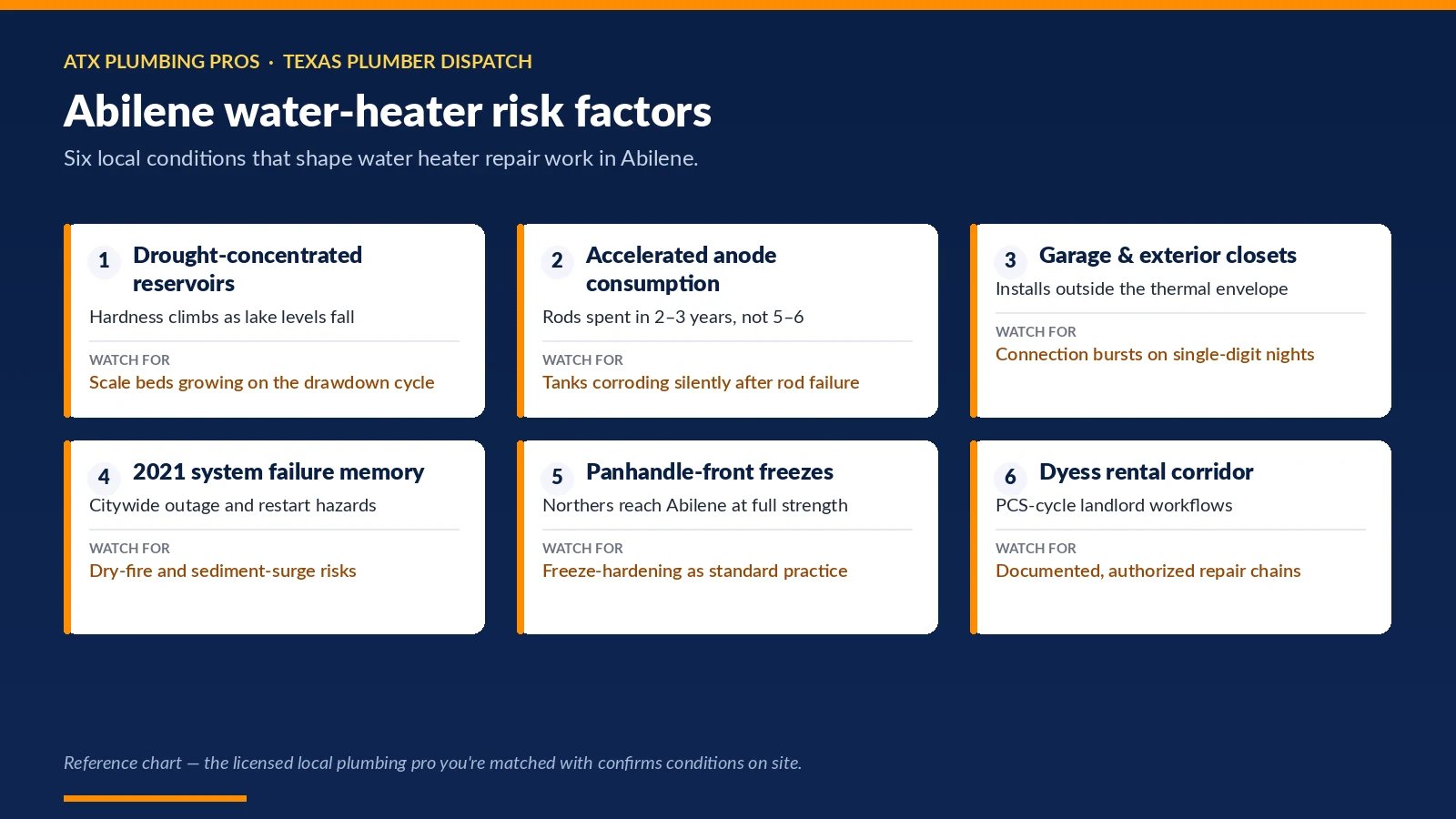
Abilene water-heater risk factors, mapped
Six local conditions decide how long an Abilene water heater lives:
| Local factor | What it does to plumbing | What to watch for |
|---|---|---|
| Drought-concentrated reservoirs | Hardness climbs as lake levels fall | Scale beds growing on the drawdown cycle |
| Accelerated anode consumption | Rods spent in 2–3 years, not 5–6 | Tanks corroding silently after rod failure |
| Garage & exterior closets | Installs outside the thermal envelope | Connection bursts on single-digit nights |
| 2021 system failure memory | Citywide outage and restart hazards | Dry-fire and sediment-surge risks |
| Panhandle-front freezes | Northers reach Abilene at full strength | Freeze-hardening as standard practice |
| Dyess rental corridor | PCS-cycle landlord workflows | Documented, authorized repair chains |
Which Abilene areas does the dispatch line cover?
Independent licensed plumbers in the network take dispatch calls across Abilene, including:
Abilene water-heater questions, answered straight
My tank rumbles and pops when heating. Is it dying?
It is announcing a scale bed — steam pockets firing through sediment on the tank floor. Caught early, a thorough flush (sometimes two) clears it and recovery improves noticeably; left for years, the sediment hardens, overheats the floor, and shortens the tank’s life structurally. Age decides the response: a rumbling 5-year-old earns a flush and an anode check; a rumbling 12-year-old earns the honest replacement conversation before it makes the decision itself.
How often should I flush a water heater in Abilene?
Annually as the floor, semi-annually when the reservoirs are down and the water runs harder — and always with an anode inspection in the same visit, because this water consumes rods years ahead of schedule. If the drain valve has never been opened, have the first flush done professionally; years of consolidated sediment can clog a cheap valve open. Households with a softener can relax toward the normal annual rhythm.
Power or water outage just ended. Can I just relight the heater?
Carefully, and only after confirming the tank is full: run hot taps until air stops sputtering and water flows steadily. Gas heaters then relight per the door plate — if the pilot will not stay lit or anything smells off, stop and get a professional. Electric heaters are less forgiving: energizing dry elements destroys them in seconds, so power stays off until the tank is verified full. After a citywide event, add a flush — restored mains push stirred sediment straight at your tank.
Is a tankless unit a good idea in Abilene water?
With eyes open, yes. The endless-hot-water and space advantages are real, but this water scales heat exchangers aggressively — plan on disciplined annual descaling through isolation valves, and strongly consider upstream softening, which several manufacturers effectively expect for warranty comfort at this hardness. Also weigh outage behavior post-2021: tankless freeze protection and operation ride on electricity. A gas tank with a standing pilot is the low-tech resilience option; the right answer depends on which risk you care most about.
The heater is in an exterior closet. What freeze prep does it need?
Insulate the exposed supply and hot-out lines — the few feet nearest the tank are where Abilene’s bursts happen — sleeve the T&P discharge pipe, weatherstrip the closet door, and on single-digit forecasts let a trickle run on a hot tap overnight. Know the heater’s cold-inlet shutoff as well as the house main, and after any hard freeze, look and listen at the closet before assuming all is well: connection splits often weep before they let go.
More Abilene plumbing searches
Start from the Abilene city guide for the full local picture, or jump straight to the search that matches your problem. The full service directory covers every guide on the site.
Cold showers, a rumbling tank, or a closet heater after a hard freeze?
Describe the symptoms, the heater’s age and where it lives — garage, closet, attic — and the line matches you with an independent TSBPE-licensed plumber who works Abilene’s water and winters every week. 24/7 dispatch.
Austin Plumbing Pros is a dispatch and referral service, not a licensed plumbing contractor. All work is performed by independent Texas-licensed (TSBPE) plumbers who hold their own license, insurance and bond. Availability varies by area and time of day.